AI content platforms: dualrank strategy explained
Thirteen specialized AI agents now drive the dual-rank strategy required for modern Generative Engine Optimization. We have moved past basic keyword matching. The new imperative involves GEO optimization protocols that satisfy both search crawlers and answer engines simultaneously.
This analysis dissects the internal mechanics of automated workflows that route tasks to distinct models rather than relying on a single generalist processor. These systems eliminate the hallucinations and endless editing cycles plaguing standard AI content writing tools. We move beyond theoretical benefits to the practical implementation of multi-LLM content routing for consistent brand voice.
Finally, the text evaluates the divergence between platforms built for simple volume and those engineered for AI visibility tracking across fragmented model outputs. You will learn why content automation platforms must integrate direct publishing hooks to maintain relevance in 2026. The goal is establishing a verifiable AI visibility score metric without inflating claims with unsubstantiated market data. Success depends on recognizing that specialized AI agents are no longer optional features but fundamental requirements for surviving the dual-rank strategy environment.
The Role of GEO Optimization in Modern AI Content Strategy
Defining GEO Optimization vs Glorified Autocomplete
Generative Engine Optimization targets LLM citation rather than traditional link placement. This discipline optimizes content for LLM tools like Google's AI Overviews and Perplexity that surface answers instead of links. Discovery is shifting from rankings to AI-generated answers. This signals a fundamental change in traffic acquisition. Operators must distinguish this strategic imperative from glorified autocomplete. GEO serves as the critical differentiator between useful tools and mere text prediction.
True GEO requires AI visibility tracking to verify if models actually cite during generation. Without this feedback loop, content teams cannot measure whether their optimization efforts result in model adoption or remain invisible to the inference layer. High-volume output does not guarantee inclusion in model weights or retrieval contexts. Many organizations mistakenly equate publishing frequency with authority. They ignore the necessity of structured data and explicit citation signals that generative models prioritize.
| Metric | Traditional SEO | GEO Strategy |
|---|---|---|
| Target | Search Engine Results Pages | Direct Model Citations |
| Unit of Value | Clicks | Mentions |
| Verification | Analytics Dashboards | Citation Tracking |
Teams should shift resources from pure volume production to crafting high-authority snippets designed for direct retrieval. The cost of ignoring this pivot is total obsolescence in an environment where the interface itself provides the answer.
Deploying Specialized Agents for AI Visibility
Specialized AI agents function as discrete workers. Each is trained for specific content formats rather than relying on a single generic model. This architecture addresses the failure mode where content not appearing in AI answers stems from poor format alignment with specific model ingest preferences. The platform monitors brand visibility and citations across substantial AI models, including ChatGPT, Claude, and Perplexity. It provides granular feedback on which agent successfully secured placement. Operators gain a guide to optimizing for AI-generated answers by correlating agent type with citation success rates per model.
Coordinating multiple agents introduces orchestration complexity that single-model workflows avoid. It requires strong queue management to prevent version conflicts. Production teams must shift from writing articles to managing agent portfolios that target distinct retrieval patterns. This targeted deployment ensures resources focus on formats most likely to trigger citations in your specific domain.
GEO Platform Selection: Unified vs. Specialized Tools
Selecting a GEO platform requires distinguishing between full-cycle creation engines and point-solution intelligence trackers. Operators face a structural choice between unified agent workflows and fragmented monitoring dashboards. This separation forces teams to maintain parallel stacks for content production and visibility verification. An all-in-one architecture unifies these functions to reduce latency between draft and deployment.
| Feature | All-in-One Creation | Dedicated Tracking |
|---|---|---|
| Primary Function | Drafting and publishing | Monitoring citations |
| Workflow Integration | Native agent execution | External API hooks |
| Cost Efficiency | High volume output | Low volume audit |
Pricing for AI SEO tools varies significantly, with options ranging from entry-level monthly subscriptions to enterprise business plans. This pricing model shifts capital expenditure from variable labor costs to fixed infrastructure expenses. High-volume publishers gain margin advantages that point solutions cannot match.
Consolidated platforms introduce vendor lock-in risks that specialized tools avoid. If the central engine fails, both production and measurement capability cease simultaneously. Teams must weigh the efficiency of a single pane of glass against the durability of a best-of-breed assembly.
Specialized AI Agents vs Generic LLMs in Content Workflows
Generic large language models produce average outputs. Specialized AI agents execute set tasks for specific formats like listicles and guides. This architecture contrasts with single general-purpose models that lack format-specific constraints. A generic model might hallucinate structure. A specialized agent adheres to rigid content schemas.
| Feature | Generic LLM | Specialized Agent |
|---|---|---|
| Training Scope | Broad internet corpus | Format-specific datasets |
| Output Control | Probabilistic tokens | Deterministic structure |
| Optimization Target | General coherence | GEO optimization |
Autopilot Mode defines the operational state where these agents manage creation through publishing without manual intervention. This approach solves the visibility gap where traditional SEO fails to capture answers in LLM tools like Google's AI Overviews or ChatGPT. The trade-off is increased orchestration complexity compared to prompting a single chat interface. This separation ensures that automated workflows maintain high fidelity across different publication channels.
A critical limitation emerges when agents lack access to real-time indexing signals. Without IndexNow integration, content remains invisible to search crawlers until the next scheduled scan. Enterprises scaling output must verify that their chosen platform connects agent actions directly to indexing APIs. Validating the latency between content completion and crawler notification serves as a primary quality gate.
Automating Publishing with Autopilot Mode and IndexNow
Autopilot Mode executes end-to-end publishing by chaining agent outputs directly to CMS APIs without manual intervention. This configuration eliminates latency between content generation and public availability. Rapid deployment captures volatile traffic before competitors update their indices. The mechanism relies on IndexNow integration to push immediate sitemap notifications to search engines upon commit.
Immediate indexing introduces risk if upstream validation fails. Speed requires deterministic content schemas that generic models often violate.
- Configure the LLM workflow to validate output against a JSON schema before committing.
- This separation ensures that a hallucination in the drafting phase does not trigger an unauthorized deployment.
The architectural cost is added complexity in error handling. The benefit is a defensible position in high-velocity search environments. Operators must prioritize pipeline stability over raw throughput to maintain long-term visibility.
Validating Specialized Agent Output for GEO Compliance
Automated indexing fails when upstream content lacks the structural integrity required by generative engines. Operators must verify that specialized AI agents adhere to strict format schemas before triggering publication workflows.
- Validate schema compliance against target format requirements.
- Confirm IndexNow payloads return HTTP 200 status codes.
- Audit output for semantic density over keyword stuffing.
Generic models often produce probabilistic tokens that dilute answer engine relevance. Purpose-built agents enforce deterministic structures. Data indicates 94% of digital leaders plan to increase investment in this area, yet many skip pre-flight validation steps.
Aggressive automation carries a specific risk: invalid submissions can poison domain reputation across multiple AI platforms simultaneously. Teams building custom LLM content workflows must implement these gates to avoid flagging as low-quality sources.
AI Content Platforms and Enterprise Scaling Strategies
Specialized GEO Agents vs. High-Volume SEO Writing
Architectural choices define output utility. One approach targets citation in AI answers. The other optimizes for keyword density in traditional search results. the provider functions as a versatile AI writing platform featuring a broad template library, multi-format content generation, and an SEO-focused writing mode. Their pricing models enable scalable content creation for teams prioritizing quantity. True GEO platforms integrate real-time visibility tracking and automated indexing to influence how models retrieve and cite information.
| Feature | Specialized Agent Approach | Template Library Approach |
|---|---|---|
| Core Logic | Specialized AI Agents | Template Library |
| Primary Goal | AI Citation & Brand Tracking | High-Volume Drafting |
| Optimization | Generative Engine Optimization | Keyword Density & SERP |
| Workflow | Autonomous Agent Coordination | Manual Prompt Refinement |
Template models fail to adapt to the stochastic nature of LLM-powered content workflows. Content remains optimized for crawlers rather than conversational retrieval without dedicated agents monitoring citation patterns. Enterprises face a constraint between scaling word count or scaling authoritative presence in AI responses. Industry analysis suggests deploying agent-based architectures when brand citation in generative answers is the primary KPI.
Tracking Brand Mentions Across ChatGPT, Claude, and Perplexity
Operators monitor AI Visibility Score frequency across ChatGPT, Claude, and Perplexity to quantify brand presence in generative answers.
| Dimension | Manual Querying | Automated Tracking |
|---|---|---|
| Coverage Scope | Single model per session | Multi-model parallel polling |
| Sentiment Analysis | Subjective interpretation | Quantified positive/negative ratios |
| Temporal Resolution | sporadic snapshots | Continuous hourly monitoring |
| Data Export | Manual copy-paste | Structured API feeds |
Passive observation yields incomplete data. Active monitoring demands infrastructure investment. Teams should evaluate if their workflow requires this level of granular, cross-platform visibility. Consolidating these checks into a single dashboard reduces operational overhead for organizations needing to validate if AI models cite their website.
Custom LLM Workflows vs. Granular Prompt Analytics
This distinction separates content generation infrastructure from observational analytics. Automation platforms function as environments where technical teams build bespoke pipelines for content operations. Analytics tools analyze which specific user prompts trigger brand appearances in model outputs. Build time competes with immediate visibility as the primary operational constraint. Teams cannot alter citation frequency solely through observation because they must modify the underlying content signals. Operators use tracking data to identify high-value prompts, then feed those insights into automated creation loops. This process closes the gap between detecting a brand omission and programmatically correcting GEO strategies. Strategies remain reactive rather than corrective without this feedback loop.
| Feature | Workflow Automation | Prompt Analytics |
|---|---|---|
| Primary Function | Workflow Automation | Prompt Analytics |
| Intervention | Direct content modification | Passive observation only |
| Target User | Engineering teams | Brand marketing leads |
| Integration Scope | Full LLM pipeline | Output layer monitoring |
Use AI visibility tracking to pinpoint gaps, then execute fixes via custom agents. This dual-layer architecture maintains continuous alignment between brand intent and model behavior.
Measuring ROI and Visibility Gains from Automated GEO Platforms
Defining the AI Visibility Score Metric
The AI Visibility Score aggregates brand mention frequency and sentiment polarity across six substantial generative platforms to produce a single traction metric. This proprietary calculation weights raw citation counts against the emotional tone of the response. It distinguishes between neutral listings and active recommendations. To track mentions effectively, operators must query models including ChatGPT, Claude, and Perplexity using standardized prompt sets that isolate brand entities from generic category terms. The resulting data stream feeds a rolling average that smooths out transient model hallucinations or temporary indexing gaps.
Volume and sentiment often conflict. High mention frequency can depress the overall score if the contextual sentiment remains negative or corrective. Unlike traditional search rankings, this metric captures whether an AI model cites a source as an authority or merely references it as a counterpoint. The limitation of this approach is the opacity of underlying model weights. These shift without notice as providers update their training corpora.
| Component | Measurement Focus |
|---|---|
| Frequency | Raw count of brand citations per 1,000 queries |
| Sentiment | Polarity score of surrounding context tokens |
| Position | Order of appearance in generated responses |
Teams should implement automated polling to detect shifts in these variables before they impact traffic. Generative Engine Optimization practices now require this dual-axis tracking to validate content performance. The immediate next step is configuring a baseline audit across the target model set to establish current visibility thresholds.
Calculating GEO ROI Against Agency Rates
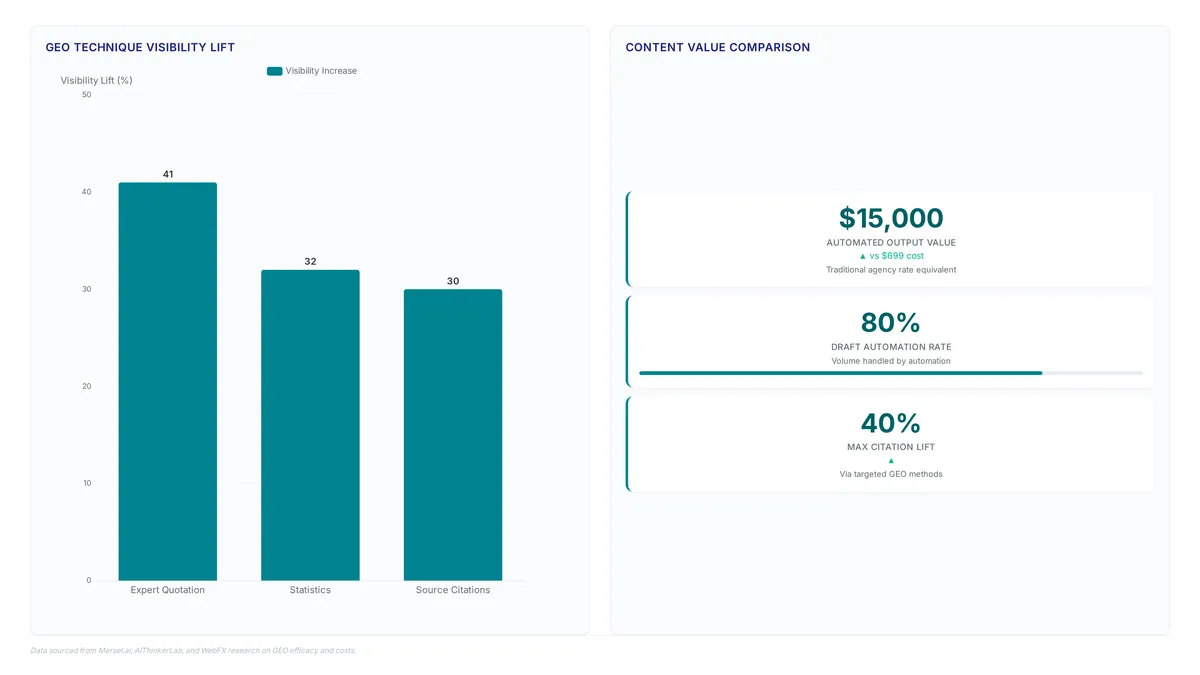
Direct financial comparison reveals that a GEO platform generating 50 articles monthly for an undisclosed amount effectively delivers content valued between a low and high estimate at traditional agency rates. This massive delta exists because automation decouples output volume from linear labor costs. It allows teams to saturate niche topics without proportional budget increases. Executing a guide to optimizing for AI-generated answers requires this scale to establish sufficient pattern density for model ingestion.
Operators tracking brand mentions in AI models face a secondary constraint: raw volume does not guarantee citation accuracy without semantic consistency. High-frequency publishing can dilute entity salience if the underlying data lacks coherent schema markup or authoritative linking structures. The hidden cost of this approach lies in the verification overhead required to maintain factual grounding across thousands of generated tokens. Teams must allocate engineering time to audit trails rather than just editing copy. The immediate step for justification involves running a parallel pilot where automation handles 80% of draft volume while human experts focus solely on schema validation and final synthesis.
Validating Hybrid SEO and GEO Strategy Implementation
Effective hybrid validation requires distinct agents for content formats rather than a single general-purpose model. Teams deploying 13+ Specialized AI Agents gain structural advantages for listicles, guides, and explainers that generic LLMs miss. This architectural choice directly addresses the mechanics of Generative Engine Optimization, where format consistency influences citation probability in AI answers.
| Content Format | Agent Specialization | Indexing Requirement |
|---|---|---|
| Listicles | Ranking logic tuning | Real-time API push |
| Guides | Hierarchical depth | Sitemap priority update |
| Explainers | Concept clustering | Schema markup refresh |
Operators must maintain IndexNow integration to ensure rapid ingestion across search and generative platforms. Relying solely on traditional crawl cycles creates a latency gap where competitors saturate the context window first. Managing multiple specialized agents demands stricter governance than a single-model workflow. Without centralized oversight, entity salience can fracture across different content types, reducing overall brand coherence.
Teams should verify that their hybrid SEO pipeline triggers immediate notifications upon publication. A common failure mode involves publishing optimized content without updating the indexing layer. This leaves high-value assets invisible to retrieval systems. Enterium recommends auditing the handoff between agent generation and indexing APIs weekly to prevent synchronization drift. The tangible outcome is a resilient pipeline where format-specific optimization translates directly into measurable visibility gains.
About
Sofia Marchetti is a B2B Content Strategist specializing in how automated content systems drive demand generation and topical authority. Her decade of experience in B2B SaaS directly informs this analysis of dual-rank strategies for AI content writers, where she bridges the gap between LLM-powered workflows and measurable revenue outcomes. Unlike generic overviews, Marchetti's approach at Enterium focuses on the practical architecture of content automation pipelines, ensuring that GEO optimization and AI visibility tracking are integrated into reproducible publishing workflows rather than treated as afterthoughts. At Enterium, a brand dedicated to documenting how modern teams scale content with vendor-neutral methodologies, she applies rigorous quality gates to automated content publishing. This ensures that strategies for optimizing content for ChatGPT, Perplexity, and traditional search engines are grounded in real-world trade-offs regarding cost, latency, and citation accuracy. Her work provides the concrete, practitioner-led framework necessary for marketing-ops teams to build durable distribution channels that compound over time.
Conclusion
Scaling this hybrid model reveals that the primary bottleneck shifts from content creation to governance overhead. While automating 80% of draft volume unlocks massive efficiency, the operational cost of managing specialized agents for listicles, guides, and explainers grows linearly without strict centralized oversight. Teams risk fracturing brand coherence if entity salience is not rigorously maintained across these distinct format-specific workflows. The window for passive indexing has closed. Reliance on traditional crawl cycles creates a latency gap that allows competitors to saturate AI context windows first.
Organizations must commit to a synchronized pipeline where format-specific optimization triggers immediate API-driven ingestion. Do not attempt to scale beyond your current validation capacity. If your team cannot audit the handoff between agent generation and indexing layers weekly, pause expansion and stabilize your existing workflow before adding new content formats. This discipline prevents synchronization drift and ensures high-value assets remain visible to retrieval systems.
Start by auditing your current IndexNow integration status this week to verify that every published asset triggers an immediate update request. Confirm that your schema validation steps explicitly check for format-specific requirements before the final synthesis stage. This single verification step ensures your expert-led content strategy actually reaches generative engines rather than sitting idle in a broken pipeline.
Operators must shift resources to craft high-authority snippets designed specifically for direct retrieval by answer engines.
Q: Why do automated workflows need distinct models rather than one general processor?
A: Relying on a single generalist processor causes hallucinations and endless editing cycles. Automated workflows route tasks to distinct models to ensure consistent brand voice and eliminate these common production errors.
Q: What capability is necessary for platforms to maintain relevance in 2026?
A: Content automation platforms must integrate direct publishing hooks to maintain relevance in the current environment. Success depends on recognizing specialized agents as fundamental requirements for surviving dual-rank strategies.
Frequently Asked Questions
Generic models often fail enterprise needs due to lack of architectural specialization. Thirteen specialized AI agents are required to drive the dual-rank strategy effectively for modern optimization.
You must implement AI visibility tracking to confirm if models cite your source material. Without this feedback loop, teams cannot measure whether optimization efforts result in actual model adoption.
High-volume output does not guarantee inclusion in model weights or retrieval contexts. Operators must shift resources to craft high-authority snippets designed specifically for direct retrieval by answer engines.
Relying on a single generalist processor causes hallucinations and endless editing cycles. Automated workflows route tasks to distinct models to ensure consistent brand voice and eliminate these common production errors.
Content automation platforms must integrate direct publishing hooks to maintain relevance in the current landscape. Success depends on recognizing specialized agents as fundamental requirements for surviving dual-rank strategies.
References