AI Content Pipeline: Build an 8-Stage System
Most AI content failures stem from bad briefs, not bad algorithms, according to Gen AI.
A reliable ai content production pipeline turns raw ideas into publish-ready assets while strictly enforcing brand voice and compliance. This approach rejects the chaotic "generate and post" mentality. Instead, it demands set workflows with clear ownership and review stages. You need an eight-stage architecture covering intake, research, generation, and optimization across text, image, video, and audio formats. The goal is a step-by-step migration that replaces tool sprawl with a unified process for speed with control. By standardizing inputs like audience pain points and banned phrases, teams ensure consistent output without sacrificing quality or regulatory safety.
The Strategic Role of Structured AI Workflows in Modern Content Operations
Defining the AI Content Production Pipeline Beyond Generate-and-Post
A strong AI content production pipeline is a repeatable system. It turns raw ideas into publish-ready assets while protecting brand voice, quality, and compliance. This architecture enforces brand alignment through set checkpoints rather than relying on post-hoc editing. Marketers need a thorough step-by-step framework to master AI content creation and move beyond basic automation. Leading organizations apply specific generation flows as a baseline for lean operations before scaling to more complex batching. Without structured intake and validation stages, teams struggle to turn raw data into draft-ready copy and visuals efficiently.
Advanced workflows cover the full loop from brief to ads. They include compliance and metrics as standard stages. Simpler approaches often stop at publication, ignoring the feedback data necessary for optimization. The content loop now includes post-publishing metrics and ad integration as standard pipeline stages, not separate marketing functions. Performance data informs future briefs automatically through this structural shift.
| Feature | Ad-Hoc Generation | Structured Pipeline |
|---|---|---|
| Scope | Single asset creation | End-to-end lifecycle management |
| Quality Control | Manual, post-generation | Embedded compliance gates |
| Feedback Loop | Disconnected | Integrated metrics drive intake |
Speed conflicts with control. Effective scaling requires a review cycle determining what content assets to keep, fix, or cut from the pipeline. Solutions resolve this by embedding validation protocols directly into the generation path. High-quality output at scale requires moving beyond simple prompting. You need a structured framework including specific brand packs and template briefs to avoid compounding errors downstream.
Executing the 8-Stage Workflow from Intake to Measurement
Operationalizing the 8-stage pipeline transforms volatile generative outputs into consistent, brand-aligned assets through rigid stage-gating. This architecture replaces the erratic "generate and post" cycle with a linear progression: Intake & brief, Research & source gathering, Outline & messaging, Generation, Editing & brand alignment, Compliance & QA, Publishing & distribution, and Measurement & optimisation. Inclusion of Compliance & QA as a distinct stage implies a dedicated cost center or time allocation ensuring content meets regulatory and platform standards before publishing.
System architecture must support closed-loop feedback. Metrics from the "publish" and "ads" stages inform the "ideation" and "drafting" stages, creating a continuous improvement cycle. A true "pipeline" includes critical pre- and post-production stages often overlooked by beginners, not just generation. Resource allocation for "human oversight" represents the primary cost implication identified in current workflows. It is a necessary component to meet quality standards alongside AI agents. The "biggest time savings" for most creators occurs specifically during the script or outline production phase after a validated topic is selected. Architectures balance speed with control, ensuring every asset passes through set checks. Teams implementing this full lifecycle see output become consistent, measurable, and easy to scale. The proposed blueprint is designed to make content output consistent, measurable, and easy to scale for small teams. Mapping current ad-hoc processes against these eight specific gates identifies missing validation layers immediately.
The Risk of Unrefined Pipelines and Google Algorithm Volatility
Recent algorithm updates highlighted the volatility of unrefined production pipelines. Significant portions of low-quality AI content faced removal. Workflows producing content failing to meet quality standards face significant removal rates, while "survivors" employ specific differentiated strategies. Failure often stems from a lack of first-hand experience and credible sources. Content may lack the depth required to survive algorithmic shifts without template briefs and structured frameworks.
Implementing rigorous quality gates carries the necessary investment cost in human oversight and dedicated time allocation for compliance. Teams must balance the speed of raw generation against the durability of the final output. High-quality output at scale requires moving beyond simple prompting to a structured framework including specific brand packs and template briefs. The implication for operators is clear: the "cheap" route of mass-producing unrefined AI content carries a high risk of total asset devaluation. Enforcing the eight-stage architecture ensures every asset passes through compliance and alignment checks before publication. Deploying a validated pipeline transforms volatile generation into a measurable, consistent operation.
Inside the Eight-Stage Architecture of a High-Performance AI Content Engine
Defining the Minimum Viable Brief Template for AI Intake
Unstructured intake data causes most generative output failures, not limitations in model capability. A minimum viable brief template acts as the primary constraint layer. It forces human operators to define specific variables before token generation begins. This structured method replaces vague prompting with fixed data structures containing Goal, Audience, Offer, Primary keyword, Tone, Format, and CTA.
Seven distinct fields must be populated to guide the ai content production pipeline. The Audience field specifies role, pain points, and knowledge level to prevent generic output. Tone definitions require explicit banned phrases alongside desired adjectives like confident or direct. Complex workflows add approver and due date fields to manage stakeholder friction without breaking the automated sequence.
| Field | Required Data Type | Failure Mode if Empty |
|---|---|---|
| Goal | Enum (awareness, leads, sales) | Misaligned conversion logic |
| Audience | String (role, pain, objections) | Generic, non-actionable prose |
| Offer | String (differentiator, proof) | Missing value proposition |
| Primary keyword | String + 3, 6 supporting topics | Poor SEO structural alignment |
| Tone | String (style + banned list) | Brand voice drift |
| Format | Enum (blog, reel, email) | Incorrect asset dimensions |
| CTA | String ( | No clear user path |
Enterium deploys this template as the mandatory entry gate for all 4A: Text generation tasks within managed services. Skipping this definition stage forces downstream editing to absorb the cognitive load, which increases revision cycles notably. The operational cost of a missing brief exceeds the time required to complete the template. Strictly defining these seven parameters stabilizes the entire downstream workflow.
Executing Component-Based Generation and Content Packs
Generating text one H2 section at a time prevents context dilution and maintains strict adherence to the approved outline. This component-based approach allows operators to inject specific brand constraints into every segment before assembling the final draft. High-quality output at scale requires moving beyond simple prompting to a structured framework that includes specific brand packs and template briefs. A single monolithic generation request often fails to capture detailed tone shifts required for different asset types within the same campaign.
A recommended content pack for one article includes a blog post, 1 hero image, 2, 3 social crops, 1 short video, voice-over track, and newsletter intro. Gen AI Last includes text, image, video, and audio in every plan starting from $10/month. This consolidation reduces the operational friction of switching between disjointed tools for each format. System architecture must support closed-loop feedback where metrics from the publish and ads stages inform the ideation and drafting stages, creating a continuous improvement cycle.
Enterium implements this via a two-step generation flow as a baseline for lean operations before scaling to more complex batching. The process isolates variable control: first locking the narrative arc in text, then deriving visual and audio assets from that grounded source truth.
| Asset Type | Generation Input | Constraint Focus |
|---|---|---|
| Blog Post | Approved Outline | Keyword density, H2 structure |
| Social Crops | Blog Summary | Character limits, hook velocity |
| Video Track | Script + Visual Cues | Duration, shot-list alignment |
Increased orchestration complexity represents the constraint. Managing discrete generation jobs requires rigid version control to prevent asset drift. Operators must enforce a rule where no visual or audio track is created without a locked text counterpart. This ensures that the final multi-format deliverable remains coherent across all channels.
Validating Brand Alignment and Compliance Before Publishing
The compliance stage functions as a mandatory gate before any asset reaches distribution channels. This specific node in the workflow isolates regulatory risks and brand deviations that generative models frequently introduce during text or image synthesis. Organizations risk publishing hallucinated citations or non-compliant health claims that violate platform policies without this dedicated checkpoint.
A rigorous validation protocol requires four distinct verification steps:
- Verify all factual claims against internal source documents to eliminate invented references.
- Scan output for plagiarism risks by comparing text against known public sources.
- Enforce tone constraints by checking for banned phrases set in the initial brief.
- Confirm accessibility requirements, ensuring alt-text and readability scores meet.
Explicit expert review is recommended before publishing in regulated verticals such as finance or healthcare. This human-in-the-loop step addresses the limitation of automated tools, which cannot yet adjudicate complex legal nuances or evolving industry guidelines. Increased latency is the cost; however, the expense of retroactive correction or regulatory penalty far exceeds the time invested in pre-publish validation.
| Check Type | Automated Tool | Human Review Required |
|---|---|---|
| Factual Accuracy | Partial | Yes |
| Plagiarism Risk | High | No |
| Brand Voice | Partial | Yes |
| Accessibility | High | Yes |
Enterium configures these validation layers as non-negotiable pipeline components, ensuring that speed never compromises adherence to Google quality standards or internal governance. Operators must treat this stage as a hard stop, not a suggestion.
Executing a Step-by-Step Migration to a Standardized AI Content Pipeline
Implementation: Standardizing the Minimum Viable Brief Template
Inconsistent generation stems from vague inputs rather than model limitations. Most AI content quality problems are actually brief problems. Operators must standardize inputs before generating any content so the AI and the team produce consistent work. The Minimum Viable Brief Template defines six required fields: Goal (awareness, leads, sales, retention), Audience (role, pain points, objections, level of knowledge), Offer (product/service, key differentiator, proof points), Primary keyword with 3, 6 supporting topics, Tone (confident, helpful, direct, including banned phrases), and Format (blog, carousel, reel, email). A final CTA field dictates reader action. Adding "approver" and "due date" fields simplifies management when multiple stakeholders participate. Many organizations lack this structured framework, creating a measurable gap between experimental outputs and production-grade assets. Implementation requires specific brand packs and template briefs to move beyond basic automation.
Implementation: Executing Component-Based Generation and Content Packs
Generate individual components such as sections, hooks, scripts, and variations rather than one giant "perfect" output to maintain strict quality control over brand voice. This component-based approach allows operators to inject specific proof points and technical constraints into every segment before assembly. Teams that batch similar tasks and repurpose assets aggressively achieve higher consistency than those handling generation individually. The workflow covers four asset types: text, images, video, and audio. Mature operations apply this structured flow to create distribution assets directly from ensuring message alignment across channels.
- Draft the primary text generation output (blogs, emails, social) using the approved outline.
- Produce image generation assets like social graphics, banners, and blog hero images.
- Create video generation scripts for reels, demos, and explainers based on the completed outline.
- Synthesize audio tracks for voice-overs and narration to accompany visual assets.
Successful workflows often integrate SEO checks directly into the generation process rather than treating optimization as a separate, post-production step. Operators must define "done" regarding tone and formatting before moving to compliance QA. This configuration ensures every asset carries the same evidentiary weight as the core article.
Implementation: Validating Brand Alignment and Compliance Before Publishing
Generic output reaches public channels when validation occurs too late. Compliance is listed as a distinct stage in the pipeline, implying a dedicated allocation for ensuring content meets regulatory and platform standards before publishing. This technical step ensures content meets quality expectations before distribution. To meet search engine quality expectations, the pipeline must capture first-hand experience, internal knowledge, and credible sources. While AI can organize ideas, raw inputs should be provided by humans, such as product notes, customer questions, and real examples. The validation process involves checking against these inputs:
- Voice consistency: Verify tone matches the set brand pack, avoiding generic internet copy.
- Specificity audit: Confirm concrete steps replace vague generalizations using internal proof like metrics or case studies.
- Readability scan: Ensure short paragraphs and clear headings support scanning.
- Source verification: Validate claims against to eliminate invented references.
| Check Type | Failure Signal | Corrective Action |
|---|---|---|
| Voice | Sounds robotic or salesy | Rewrite using banned phrase list |
| Specificity | Lacks numbers or examples | Inject internal data points |
| Readability | Walls of text present | Break into bulleted lists |
| Legal | Unverified claims detected | Remove or cite primary source |
High-quality scaling requires moving beyond simple prompting to a structured framework including template briefs. The AI content QA checklist requires verifying claims, adding citations to avoid invented references, and rewriting content too close to known sources. Teams must execute a weekly review cycle to determine which assets to keep, fix, or cut from the pipeline. Embedding validation rules directly into the workflow transforms quality control from an afterthought into a deterministic system property.
Measurable ROI and Quality Gains from Enterprise-Grade AI Content Automation
Defining Content Packs as the Unit of AI ROI
Scaling output requires shifting from single-article generation to producing a unified content pack. This unit comprises an SEO-optimized blog post, a 16:9 hero image with social crops, a 30, 60 second video with captions, and a newsletter intro. Attempting to customize these assets manually at the required pace is unsustainable, making structured adoption a necessity rather than an option for maintaining output velocity. Without a set framework including specific brand packs, teams struggle to move beyond basic automation to achieve high-quality results at scale.
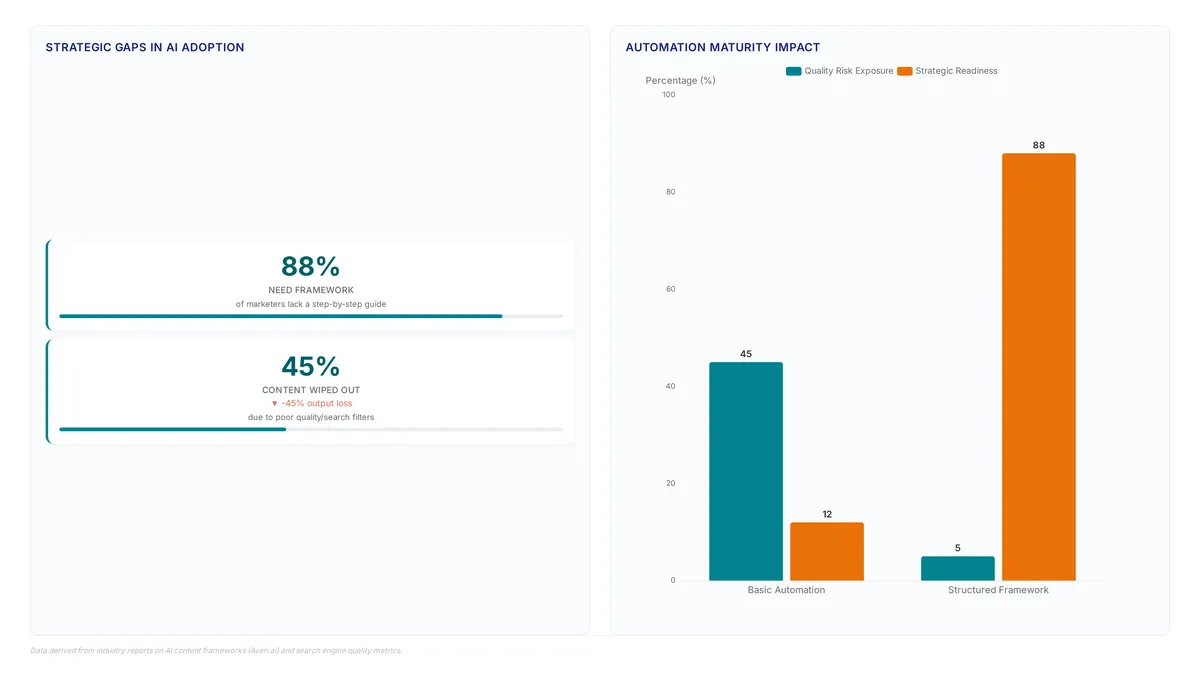
Enterium solves this by defining the content pack as the standard deliverable. Because Gen AI Last includes text, image, video, and audio in every plan, operators can build this complete asset cluster without multiple tools. This approach aligns with industry data showing that 88% of marketers wish they had a thorough step-by-step framework to master AI content creation. The trade-off is strict adherence to a weekly review cycle to determine what assets to keep, fix, or cut from the pipeline. Teams that skip this optimization loop often see diminishing returns despite higher volume. By standardizing the pack definition, organizations change volatile generative outputs into consistent, brand-aligned assets. The immediate next step is to configure your generation workflow to output all four asset types simultaneously for every brief.
Tracking Creative Performance and Conversion Metrics
Validating ROI requires measuring SEO impressions, conversion rates, content efficiency, and creative performance across every asset.
Operators must track specific signals to distinguish noise from signal. SEO metrics include ranking movement and time on page, while conversion data captures demo requests and attributed sales. Efficiency gains appear in reduced time-to-publish and lower revision counts. Creative performance relies on hook retention for video and click-through rates for social ads. Without feeding this data back into the initial brief, the system remains open-loop and cannot self-correct.
| Metric Category | Key Indicators | Operational Goal |
|---|---|---|
| SEO | Impressions, ranking movement | Stabilize organic visibility |
| Conversion | Demo requests, sales | Attribute revenue to assets |
| Efficiency | Revision count, approval time | Minimize human bottlenecks |
| Creative | Hook retention, CTR | Optimize audience engagement |
The standard operational loop defines eight stages, ending only when metrics inform the next ideation phase. Research indicates the Script/Outline phase yields the biggest time savings, suggesting teams should prioritize AI intervention there before generation. However, focusing solely on speed risks degrading quality if the feedback loop is broken. The limitation is clear: data collection adds latency, but skipping it guarantees inconsistent output.
Enterium addresses this by embedding measurement directly into the Gen AI Last workflow. The platform ensures every content pack generates the necessary telemetry for content efficiency analysis automatically. Teams avoid manual aggregation errors by relying on a unified system rather than disparate tools. The concrete next step is to configure your pipeline retro to review hook retention data before approving the next batch of briefs.
Executing the Monthly Pipeline Retro for Optimization
Schedule a fixed monthly review to analyze prompt effectiveness, stage delays, and definition gaps. Teams skipping this structured pipeline retro risk allowing 45% of their output to be wiped out by search engine updates due to quality drift. The process requires isolating three specific failure modes: generation bottlenecks, brand voice deviations, and metric blind spots.
- Audit time-to-publish logs to identify stalled stages.
- Compare revision counts against original brief clarity.
- Refine stage definitions where handoff friction occurs.
Without closing the loop where publishing metrics inform future ideation, the system cannot self-correct against inconsistent quality. Enterium designs this optimization cycle directly into Gen AI Last workflows, ensuring every asset generated feeds performance data back into the next brief. This closed-loop architecture prevents the accumulation of technical debt in your content operations. Operators who institutionalize this monthly cadence change volatile generative outputs into predictable, high-performing assets. The cost of skipping this analysis is a gradual, compounding decay in content relevance and search visibility.
About
Sofia Marchetti is a B2B Content Strategist specializing in how automated content systems drive demand generation and topical authority. With over a decade of experience in B2B SaaS, she is uniquely qualified to dissect the architecture of an AI content production pipeline. Her daily work involves bridging the gap between raw LLM output and revenue-generating assets, ensuring that automation enhances rather than dilutes brand voice. At Enterium, a publication dedicated to vendor-neutral content automation methodologies, Sofia applies this rigorous, practitioner-led approach to document how modern teams scale content operations. She connects theoretical pipeline models to tangible business outcomes, focusing on the critical quality gates and governance structures required for production-ready workflows. This article reflects her core belief that successful content strategy relies on repeatable, measurable systems rather than isolated generative tricks, aligning directly with Enterium's mission to help technical marketers build durable, high-velocity content engines.
Conclusion
Scaling generative workflows reveals a critical fragility: without embedded telemetry, speed actively erodes brand consistency. The operational cost of disjointed tools is financial but cognitive, as teams waste cycles reconciling conflicting outputs rather than refining strategy. As the industry shifts toward autonomous "AI agents" and Model Context Protocol tools, relying on manual prompt chains becomes a liability that stifles true scalability. You must transition from linear generation to closed-loop systems where performance data automatically dictates future briefs.
Implement a strict monthly pipeline retro immediately to audit generation bottlenecks and brand voice deviations. This specific cadence prevents the compounding decay of quality that leaves nearly half of all output vulnerable to search algorithm updates. Do not wait for a quarterly review; the velocity of AI demands weekly or monthly correction cycles to maintain relevance. Start this week by isolating your top three stalled stages in the current workflow and mapping their revision counts against original brief clarity. This single diagnostic action exposes whether your friction stems from tool limitations or ambiguous definitions. Enterium solves this by baking these feedback loops directly into the Gen AI Last architecture, ensuring every asset generated feeds performance data back into the next ideation cycle. Secure your long-term content viability by making data-driven refinement the engine of your production line today.
Frequently Asked Questions
Most failures stem from bad briefs rather than bad algorithms. Standardizing inputs like audience pain points can reduce revisions by 50% before you ever begin the actual drafting phase.
Teams can access text, image, video, and audio in every plan starting from $10/month. This consolidation reduces the operational complexity found in scattered tool stacks.
Google updates have wiped out 45% of unrefined AI content due to poor quality control. Structured workflows with compliance gates protect your assets from this volatility effectively.
The biggest time savings occur during the script or outline production phase. Locking structure here reduces revisions by 50% and prevents expensive rework later in the process.
A defined workflow enforces brand alignment through embedded compliance gates. This approach ensures every asset meets quality standards before publication without needing extensive manual editing afterward.
References