AI-assisted creation: A 30/60/90 plan for lean teams
Small businesses can build AI marketing workflows for a modest monthly cost without a technical team. AI-assisted content creation acts as a force multiplier for lean teams, but only if operators treat every output as a rough draft requiring strict human oversight. Modern marketing stacks now integrate generative tools to summarize call transcripts and segment audiences by role or purchase history, yet the operational mechanics demand we verify pain points before drafting copy. We are looking at specific applications: turning one source document into multiple nurture emails and social posts while maintaining tone and accuracy.
The path forward involves a concrete 30/60/90-day rollout plan to institutionalize these practices without inviting compliance risks. We must address critical guardrails for personal data and the legal nuances of CAN-SPAM or TCPA regulations when generating tailored snippets at scale. Speed means nothing if it destroys trust. By anchoring velocity in verified facts, organizations can close the gap between rising content demands and static headcounts.
The Role of AI-Assisted Content Creation in Modern Marketing Stacks
AI-Assisted Creation as a First Draft Workflow
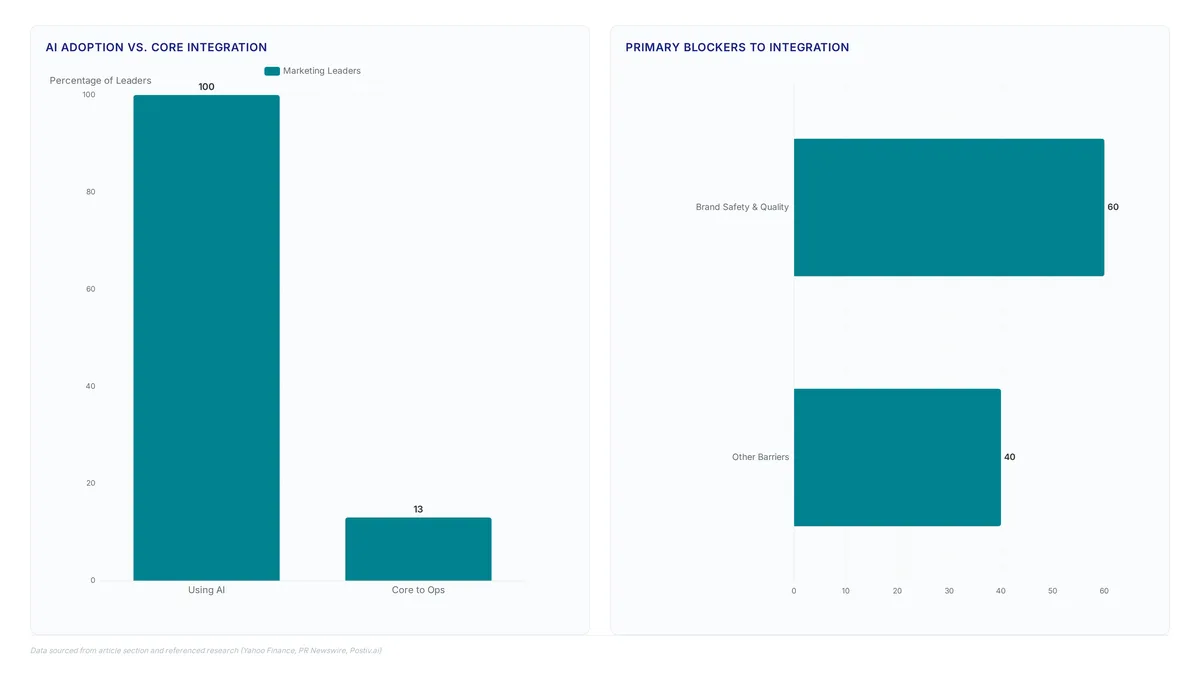
Think of AI-assisted creation as a drafting engine, not an author. The workflow is simple: tools draft copy, outlines, summaries, and email variations, but humans review them before publication. Many marketing leaders report using AI for content, yet only a fraction consider it core to operations. Why the hesitation? Because effective deployment requires viewing the model strictly as a producer of "first drafts, not finished assets." Teams use these tools to summarize call transcripts or convert one blog post into multiple channel variations, ensuring the structure remains ready for editing rather than finished.
Solopreneurs often allocate funds for a functional stack, typically pairing one creation tool with an analytics layer. This separation allows lean teams to personalize outreach by industry or role without the complexity of enterprise suites. However, scaling personalization introduces regulatory friction. U.S. Operators must verify that segmented snippets comply with CAN-SPAM and TCPA rules before sending.
The real danger lies in the "confidence error," where the model produces plausible but factually incorrect statements. Speed gains from repurposing content vanish instantly if reputation takes a hit from hallucinated data or unlicensed visuals. You must assign a human owner to fact-check every claim and verify asset licenses before any asset goes live. The technology accelerates volume, but judgment remains the exclusive domain of the marketing team.
Repurposing Blog Posts into Nurture Emails and Sales Sheets
Take a single blog post and run it through AI-assisted creation to generate nurture emails, social posts, and one-page sales sheets. The output is a provisional draft requiring human verification, not a finished asset. Teams segment lists by industry or role to generate tailored snippets, addressing the definition of personalization at scale without manual rewriting.
| Input Asset | Output Variation | Review Focus |
|---|---|---|
| Long-form Blog | Nurture Email | Tone alignment and call-to-action clarity |
| Long-form Blog | Sales Sheet | Factual accuracy of feature claims |
| Long-form Blog | Social Snippet | Context preservation and hook strength |
Generative tools function poorly as autonomous agents capable of independent judgment. When speed of production clashes with the risk of hallucinated claims in sales collateral, speed usually wins unless you force a stop. Basic tools generate text only when prompted. Advanced AI agents can research topics and schedule posts autonomously, which increases the blast radius of any single factual error.
Configure pipelines where every variant passes through a mandatory human quality gate before distribution. This approach ensures compliance with CAN-SPAM and TCPA regulations while maintaining brand voice consistency across channels. Skipping human review causes the rapid propagation of confident errors across multiple customer touchpoints. Assigning one owner for final review helps maintain trust while scaling output volume.
CAN-SPAM and CCPA Compliance in Personalized Prompts
Prompt injection of customer PII creates immediate legal exposure under CAN-SPAM and CCPA/CPRA statutes if the tool's policy forbids it. Including names, emails, or purchase history in prompts violates data minimization principles unless the vendor contract explicitly permits processing such data. The TCPA further complicates SMS workflows by imposing strict liability for unsolicited messages, regardless of whether a machine drafted the text. Operators must verify that their chosen stack respects opt-out mechanics and does not retain personal data for model training.
| Regulation | Scope | Prompt Risk |
|---|---|---|
| CAN-SPAM | Commercial Email | False headers or missing physical address in AI generation |
| TCPA | SMS/Robocalls | Auto-dialing without prior express written consent |
| CCPA/CPRA | Data Privacy | Leaking personal identifiers into third-party model weights |
Never input raw customer databases into public interfaces. Teams should honor opt-in and opt-out lists, and keep personal data out of prompts unless the tool's policy allows it. Relying on manual review alone fails because human auditors cannot trace where a specific prompt's data residues persist.
Operational Mechanics of Human-AI Content Workflows
Human Review as the Final Trust Gate in AI Workflows
Assigning one owner for final review establishes the mandatory checkpoint where brand voice and factual accuracy are verified before publication. Autonomous agents now execute research and drafting workflows, yet industry reports indicate that only 13% of marketing leaders consider AI core to their operations due to unresolved quality risks. Automation scales volume while human judgment validates trust.
Generative models propagate confident errors or violate privacy constraints embedded in source data without a assigned reviewer. The process requires a clear owner and review step for each task. The responsible editor must confirm disclosure compliance and validate claims against original source notes so no hallucinated data enters the public domain. This step prevents the reputational damage caused by unverified synthetic content. Effective workflows treat AI output as a provisional draft, not a finished asset, requiring explicit human sign-off to proceed.
| Workflow Stage | AI Responsibility | Human Responsibility |
|---|---|---|
| Drafting | Generate variations | Select tone and direction |
| Fact-Checking | Retrieve context | Verify accuracy of claims |
| Publishing | Format and schedule | Final trust gate approval |
Implementing a strict single-owner rule for this final verification step helps maintain accountability. Adding a human node reduces maximum velocity but drastically lowers error rates. Organizations must accept this cost to sustain long-term credibility.
Deploying Style Guides and Source Notes to Fix Tone Mismatch
Provide the model with a style guide and two strong sample pieces to immediately anchor brand voice generation to specific syntactic patterns rather than generic probabilities. Output Accuracy improves when operators keep source notes nearby during the drafting process, allowing for real-time verification of claims against original data. This proximity reduces the latency between claim generation and fact-checking, preventing confident errors from entering the review queue.
Effective prompt engineering requires clarity about desired output and set constraints like tone to keep content on-brand. Operators must treat every AI output as a first draft requiring human validation before publication.
| Input Component | Function | Risk if Omitted |
|---|---|---|
| Style Guide | Defines vocabulary and sentence structure | Generic, off-brand phrasing |
| Sample Pieces | Provides concrete examples of tone | Inconsistent voice across drafts |
| Source Notes | Grounds claims in verified data | Hallucinated statistics or facts |
Increased prompt token usage occurs, but the reduction in revision cycles justifies the compute expense.
Preventing Confident Errors and Privacy Breaches in Prompts
Generative tools frequently output confident errors that require rigorous human verification before publication. These hallucinations present false claims with high syntactic certainty unlike simple typos, demanding that operators fact-check every assertion against primary sources. Operational risk escalates when teams paste restricted customer data into public prompts, potentially violating privacy policies and data governance rules.
Teams must avoid pasting customer data into prompts unless the tool's specific policy explicitly allows such ingestion. This constraint forces a workflow separation where sensitive identifiers are redacted before any external processing occurs. Small businesses often engage specialist studios for visual assets requiring CGI or photorealistic rendering rather than relying solely on automated generators. General image tools suffice for concept mockups, yet complex multimedia post-production requires the licensed expertise found in professional studios. This distinction prevents intellectual property disputes regarding model releases and asset licensing that frequently plague fully automated visual pipelines.
| Risk Factor | Mitigation Strategy | Required Action |
|---|---|---|
| Confident Errors | Manual Fact-Checking | Verify claims against source notes |
| Data Leakage | Input Sanitization | Redact PII before prompting |
| IP Violation | Specialist Review | Consult studios for complex visuals |
Implementing a mandatory review step where AI outputs remain unpublished until a assigned owner validates accuracy and privacy compliance is necessary. This human-in-the-loop gate helps prevent confident errors from damaging brand trust.
Executing a 30/60/90-Day AI Content Rollout Plan
Defining the 30/60/90-Day AI Pilot Structure
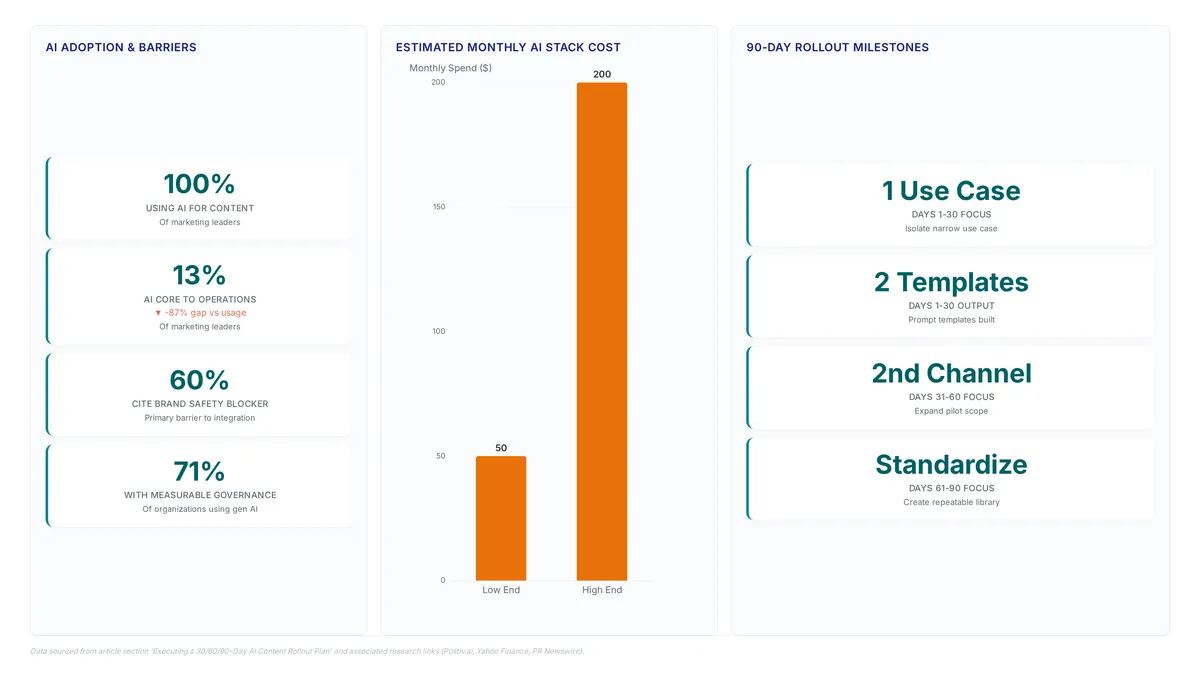
Days 1 through 30 require isolating one narrow use case, such as email subject lines, to establish a performance baseline. Teams must build two prompt templates and record current throughput and error rate before introducing automation. This initial constraint prevents scope creep while validating the agent execution model against manual output. The limitation is that single-channel data may not reflect broader brand voice inconsistencies across diverse formats. Operators should treat this phase as a controlled experiment rather than a production launch.
- Select a low-risk content type like call-note summaries.
- Document existing time-to-publish metrics without assistance.
- Deploy Enterium workflows to generate draft variations.
Days 31 through 60 expand the pilot to a second channel, such as social captions, using a review checklist. This stage introduces a glossary of preferred terms to maintain consistency as volume increases. Days 61 through 90 focus on standardizing successful patterns into a repeatable prompt library while dropping ineffective workflows. Reporting shifts from raw speed to net time saved and reduced error rates.
Expanding too quickly dilutes the quality signal needed to tune brand voice rules effectively. This disciplined approach ensures that 71% of organizations using generative AI do so with measurable governance.
Deploying Quick-Win Prompt Templates
Operators initiate the guide to building a prompt library by hardening two specific templates against data leakage before scaling volume.
- Paste the source outline into the
Outline to drafttemplate, instructing the model to write a 300-word first draft while flagging unverified claims. - Feed the completed blog post into the
Blog to emailtemplate to generate a 100-word nurture message with a single call to action.
This workflow aligns with the shift from basic assistants to autonomous agents that research gaps and schedule posts without manual intervention. Successful deployment requires strict privacy constraints where operators strip personally identifiable information from inputs unless the tool explicitly permits sensitive data processing. Technical specificity in prompts reduces hallucination rates by defining output length and format constraints upfront. The cost of skipping this validation step is measurable: unverified claims in automated drafts erode brand trust quicker than manual errors due to perceived scale.
Speed and accuracy often fight each other; increasing automation velocity without corresponding guardrails amplifies noise alongside signal. Teams must appoint specific employees to approve all AI-assisted content before it reaches external channels. The immediate next step is to run both templates on five existing assets and measure the time saved versus manual drafting.
Standardizing Workflows and Measuring Time Saved
Days 61 through 90 require teams to standardize successful workflows, create a prompt library, and drop ineffective processes. This phase shifts focus from experimental drafting to measuring time saved and reducing error rates across the production pipeline. Operators must compare current throughput against the baseline recorded in the initial pilot month.
For most small businesses, the expected spend for a working AI content stack remains between a modest monthly fee. Effective technical use demands clarity about desired output and set constraints like tone or length to minimize editing. Teams should codify these constraints into reusable templates rather than rewriting instructions for every task.
- Audit all active prompts and archive those with high rejection rates.
- Document the exact parameters for Outline to draft and Blog to email flows.
- Calculate total hours saved by comparing manual draft times to automated outputs.
The shift from simple assistants to autonomous agents changes how workflows function, moving execution from manual prompting to scheduled tasks. However, this autonomy increases the risk of brand drift if review checklists are not rigorous. Without this validation step, scaling volume merely accelerates the distribution of low-quality assets.
Operators who skip the standardization step often find their error rates climbing as volume increases. Freeze the top two performing templates and discard the rest before attempting further expansion.
Measurable ROI from Repurposing Content Across Channels
Defining the AI Repurposing Workflow for Small Teams
One blog post converts into a nurture email, social posts, and a one-page sales sheet, with the structure ready for editing. This repurposing workflow requires a assigned owner to validate accuracy before distribution. Enterprise data indicates that while AI handles volume and variation, humans must focus on strategy and quality review to maintain brand integrity. Small teams operating without this oversight risk publishing confident errors that damage credibility. Teams often fail by chasing every new tool instead of executing consistently with two or three specific applications. Enterium solutions enforce the necessary human-in-the-loop checkpoint where a editor verifies tone and facts against source notes. Skipping this review step creates a single point of failure in the content pipeline.
A clear owner prevents the "set and forget" error mode common in automated systems. Enterium recommends defining this assignment explicitly in your operational charter. Speed gains vanish if the review queue becomes a bottleneck, so assign one person to clear the queue daily.
Executing Blog-to-Email Conversion with Specific Prompts
Paste the source URL into the prompt "Summarize this blog post into a 100-word nurture email with a clear subject line and one next step" to generate a first draft instantly. This repurposing workflow converts long-form analysis into concise nurture assets without manual rewriting. The resulting output requires human editing to align tone with brand voice before distribution.
| Component | Requirement | Risk if Skipped |
|---|---|---|
| Subject Line | Clear and specific | Low open rates |
| Body Copy | Maximum 100 words | Reader fatigue |
| Call to Action | One single next step | Confused prospects |
Teams must treat AI as an autonomous agent capable of executing set text transformations rather than a creative substitute. Distinct from basic assistants, these systems research topics and schedule posts to execute workflows with minimal intervention evolution of AI. Enterium solutions embed this logic directly into content pipelines to maintain strict format adherence. A common failure mode involves publishing the raw 100-word summary without verifying that the next step matches the recipient's current lifecycle stage. Static templates often ignore purchase history, leading to irrelevant offers that trigger unsubscribe events.
Successful deployment requires separating the generation layer from the compliance review. Operators should verify that no personal data enters the prompt unless the tool policy explicitly permits it under CAN-SPAM or CCPA/CPRA frameworks. The operational benefit is speed, but the constraint remains legal liability for inaccurate claims or privacy breaches.
Enterium provides the governance layer necessary to scale this workflow safely across marketing teams. Deploy the "Blog to email" template within an Enterium workflow today to standardize your nurture production.
Mitigating Privacy Risks When Personalizing Content Snippets
Exclude personally identifiable information from prompts unless the tool policy explicitly permits it. Generating tailored snippets by segmenting lists by industry or role increases relevance but introduces compliance liability if raw data enters third-party systems. Teams must verify CAN-SPAM, TCPA, and CCPA/CPRA requirements before automating outreach to U.S. Audiences. This regulatory review prevents fines associated with unsolicited contact or mishandled consumer data.
Sanitizing data slows generation but prevents catastrophic reputational damage. Enterprises often halt pilots because legal teams cannot validate data flows in real-time. Enterium provides governance frameworks that embed these compliance checks directly into the content pipeline, ensuring personalization scales without violating trust boundaries. Operators should treat every prompt as a potential public disclosure.
About
This article is informed by extensive experience in the field.
Conclusion
Scaling AI content creation breaks when legal liability outpaces generation speed. While basic tools offer low monthly costs, the operational expense of unverified claims or privacy breaches creates a hidden tax that destroys ROI. Organizations cannot sustain a model where every prompt requires manual legal review; this bottleneck halts production and negates the speed advantage of automation. The path forward demands embedding governance directly into the workflow rather than treating compliance as an afterthought.
Teams must adopt a separated architecture where generation and compliance review operate as distinct, validated layers. Do not attempt to scale personalized outreach without first establishing strict boundaries around personally identifiable information. The immediate priority is to sanitize all inputs before they reach third-party models to prevent data leakage. Start this week by auditing your current prompt library to identify any instances where raw customer data enters external systems without explicit policy permission.
This discipline ensures that speed never compromises regulatory standing under frameworks like CAN-SPAM or CCPA. Enterium solves this by providing the necessary governance layer to standardize these checks within your existing pipeline. Deploy the Enterium "Blog to email" template today to enforce these safety standards automatically while maintaining production velocity.
Frequently Asked Questions
This budget allows lean teams to implement assistive partners that accelerate research while avoiding the need for expensive developer resources or complex enterprise suites.
This investment usually covers one creation tool paired with an analytics layer to ensure personalization remains compliant with data privacy rules.
Many leaders cite brand safety and quality control as their main blocker to deeper integration. Without strict human oversight, the risk of confident errors damaging reputation often outweighs the speed gains from automated drafting tools.
Operators must view every AI output as a first draft requiring strict human review. Treating generated text as a finished asset invites factual errors and potential violations of CAN-SPAM or TCPA regulations regarding personalized snippets.
Teams should pick one narrow use case like email subject lines to test during the first 30 days. This approach allows you to record baseline throughput and error rates before scaling to broader content creation tasks.
References