AI content briefs: cut creation from 3 hours to 10 minutes
Manual brief creation burns three hours per document. AI content briefs cut that deficit to ten minutes. Research confirms AI tools slash generation time from a manual baseline of one to two hours down to approximately ten minutes (content briefs). Yet organizations still churn out poor content briefs lacking the precision modern search demands, sabotaging their SEO optimization (poor content briefs). Speed defines the gap between winners and the rest.
This guide details multi-agent architectures that handle complex brief generation without hand-holding. We move from static documents to flexible, data-driven automated SEO brief systems built for generative engine optimization.
The Role of AI Content Briefs in Modern Content Strategy
Defining AI Content Brief Automation and GEO-Aware Shifts
AI content brief automation replaces static keyword lists with pipelines ingesting live search data to map entity relationships. Manual processes bloat from an intended hour to three as teams wrestle with data pulls and competitor analysis. Automation reverses this: AI tools drop the time required to create a content brief from 1 to 2 hours down to roughly 10 minutes. This shift frees teams for strategy over data entry.
A geo-aware brief layers semantic topic clusters atop traditional keywords to capture regional nu. This structure satisfies generative engine optimization, where systems weigh interconnected concepts over term frequency. Static keyword lists produce isolated content that fails to build topical authority. Modern approaches demand entity extraction to satisfy both crawlers and answer engines.
| Feature | Traditional Brief | Automated GEO Brief |
|---|---|---|
| Data Source | Historical snapshots | Live SERP ingestion |
| Structure | Keyword lists | Semantic clusters |
| Scope | Single page focus | Topical authority map |
Speed creates dependency on ingestion logic quality. Poorly tuned extractors spread noise faster than humans. Validation gates remain mandatory.
Operationalizing Automated Pipelines for SERP Data Ingestion
Automated briefs ingest SERP data programmatically, using NLP to extract entity relationships. This pipeline maps competitor gaps in minutes, replacing manual compilation. SERP data ingestion acts as the core input, parsing top-ranking articles for relevance without intervention. Natural language processing identifies semantic connections static lists miss.
Data staleness poses a risk during high-volatility events where rankings shift hourly. Effective pipelines balance freshness against stability by controlling how raw data is gathered. Critical briefs require human review of the AI's SERP and competitor analysis to align suggestions with the desired angle.
Configuring pipelines to output structured briefs meeting generative engine optimization standards shifts the operator's role from gathering to quality assurance. Teams scale output while maintaining semantic density.
| Component | Function | Output |
|---|---|---|
| Ingestion Layer | Fetches raw SERP | HTML/JSON |
| NLP Engine | Extracts entities | Relationship Map |
| Generator | Structures brief | Markdown/Doc |
Adopting this architecture answers the automation question via volume thresholds. Since manual briefs waste up to three hours per piece, pipelines yield immediate efficiency gains for repeatable needs.
Traditional SEO Briefs Versus GEO-Aware Structural Alignment
A standard SEO brief offers a target keyword, rough heading outline, and competitor URLs, often rushed under time pressure. This approach fails generative engine optimization due to lacking semantic depth. A GEO-aware brief includes search intent classification and semantic topic clusters to ensure completeness.
| Feature | Traditional SEO Brief | GEO-Aware Brief |
|---|---|---|
| Core Input | Target keyword | Intent + Entity clusters |
| Structure | Rough heading outline | Semantic topic map |
| Data Source | Static competitor URLs | Live SERP ingestion |
| Optimization | Term frequency | Entity relationship density |
Adopt AI brief automation because manual processes cannot sustain modern topical authority velocity. Shifting from keyword lists to entity maps changes validation against search algorithms. Treat semantic topic clustering as flexible input, not fixed output. Integrating human-in-the-loop validation after cluster generation balances scale with precision, preserving editorial control.
Inside Multi-Agent Architectures for Brief Generation
Specialized Agents in Multi-Agent Brief Pipelines
Discrete units handle specific transformations in a multi-agent architecture. A research agent pulls live SERP data while a competitor analysis agent scrapes and summarizes content structure. Large volumes of search results yield dominant themes and extracted key entities through this division. A brief generation agent then structures the final output.
| Agent Role | Primary Function | Output Target |
|---|---|---|
| Research | Data Ingestion | Raw SERP Metrics |
| Analysis | Pattern Recognition | Structural Summary |
| Generation | Synthesis | Final Brief |
These pipelines combine Large Language Models, planning agents, memory layers, and prompt chaining. The research agent retrieves data so the analysis agent interprets it, keeping the brief focused. This architecture supports generative engine optimization by linking claims to fresh evidence rather than training set memorization. Properly configured, pipelines turn raw query data into actionable briefs without manual synthesis. Replacing subjective interpretation with consistent data handling creates the gain. Structured workflows and clear review checkpoints enable scaling without quality loss.
Closed-Loop AI Visibility Tracking for Brief Optimization
Refining brief quality requires tracking which elements correlate with outcomes. Monitoring where a brand is mentioned across AI platforms feeds data back into the brief pipeline. Topics where a brand holds content but lacks citations indicate a gap. AI agents track these correlations and modify future guidance, ensuring briefs reflect patterns from a specific library rather than generic SEO data. Implement a loop: monitor platform responses, map citations to source briefs, identify omissions, and rewrite generation rules. Unlike standard SEO metrics, this addresses generative engine optimization by focusing on retrieval patterns. Data teams struggle because most brief systems generate metrics disconnected from business outcomes.
| Metric Type | Traditional SEO | GEO Tracking |
|---|---|---|
| Focus | Keyword Ranking | Prompt Citation |
| Data Source | Search Engines | LLM Responses |
| Action | Content Update | Brief Restructuring |
Downstream content fails when a research agent ingests live data but the final brief omits high-value entities. The system modifies guidance automatically based on visibility signals. Balancing automation with human insight carries a cost. Deploy this complex architecture when brief volume exceeds manual capacity or brand voice consistency degrades.
Single-Agent Limitations in Competitive Topic Clusters
Output quality suffers when a single-agent generator uses one large language model for the entire brief in a single pass. Relying on one model limits the ability to validate semantic topic clustering against live signals. A solitary agent must compress competing objectives into a single context window, unlike multi-agent architectures separating ingestion from planning. This constraint results in superficial coverage of niche entities specialized agents would flag.
| Feature | Single-Agent Pass | Multi-Agent Sequence |
|---|---|---|
| Context Scope | Fixed token limit | Distributed memory |
| Validation | None (linear) | Iterative checking |
| Output Depth | Variable | Consistent |
The core failure mode is the inability to cross-reference SERP data ingestion with brand constraints simultaneously. An agent attempting both defaults to generic templates rather than deriving unique angles from competitor gaps. Implementation quality varies by architectural isolation. Operators building a content brief pipeline must recognize that linear generation cannot replicate recursive validation. The result is a brief appearing complete but failing to guide writers toward distinguishing insights. Decomposing generation into discrete, validating steps ensures rigor.
Building a Scalable Brief Automation Pipeline
Phased Brief Automation: From Keyword Clusters to Link Rules

Free topical map generators create clustered strategies in 60 seconds, yet raw speed often sacrifices structural depth. A scalable pipeline requires phased implementation, starting with a keyword opportunity list segmented by topic cluster and intent type. Skipping steps risks low entity density. Velocity conflicts with specificity; rapid generation dilutes brand voice if templates lack guardrails. Automated systems need explicit rules to infer detailed internal linking suggestions. While Large Language Models generate engaging headlines, they require structured planning agents for logical flow. Ignoring this separation yields content ranking for keywords but failing to convert due to misaligned context. Treat the brief as a flexible data object passed between specialized agents, not a static document.
Executing Pilot Batches and Measuring Time-to-Publish Metrics
Run initial batches on low-risk topics to validate template fidelity. Defining a pilot group across distinct intent clusters isolates variable performance. This limits the blast radius of coordination overhead if logic requires adjustment. Integrate generated briefs directly into the content calendar using API hooks, avoiding manual CSV imports. Automation workflows for an AI content pipeline treat briefs as versioned artifacts requiring acceptance tests. Configuration layers can block draft generation when entity density falls below thresholds.
Track time-to-publish per article to measure friction, not just velocity. Success metrics must include organic traffic growth per article over a set window. Technical teams can build these loops with specific owners and guardrails. A common failure mode is optimizing for speed while neglecting the fact check task. Rushing pilots without strict validation gates increases editorial rework. Establish a human sign-off step after automated linting but before publication. This hybrid model ensures generative engine optimization requirements meet brand safety. Manual review of structural outlines prevents downstream hallucination. Focus on reproducible steps where every brief carries citation tags for source verification. The goal remains reducing manual bottlenecks without sacrificing factual grounding.
Validating Brand Voice Templates and AI Mention Frequency
Validate brand voice templates by enforcing style embeddings before generation. Treat briefs as versioned artifacts requiring acceptance tests to prevent off-brand output. A primary constraint involves draft completeness; with specific angles and tone guidelines, AI produces content approximately 70% complete. This metric defines the baseline for human editorial effort.
Track AI mention frequency across platforms to detect brand dilution. Excessive self-referential language signals prompt constraint failure. Configuration rules can block draft progression when entity density falls below thresholds. Coordination overhead increases when teams skip validation gates to accelerate velocity. Unverified briefs generate downstream rework exceeding initial savings. The table below contrasts validation strategies.
| Validation Mode | Target Asset | Latency Impact |
|---|---|---|
| Strict Embedding | Brand Campaigns | High |
| Frequency Count | Technical Docs | Low |
| Manual Review | Legal Content | Variable |
Isolating pilot batches allows teams to calibrate thresholds before full deployment.
Measurable ROI from Automated Brief Infrastructure
Automated Briefs as Capability Multipliers for Editorial Strategy
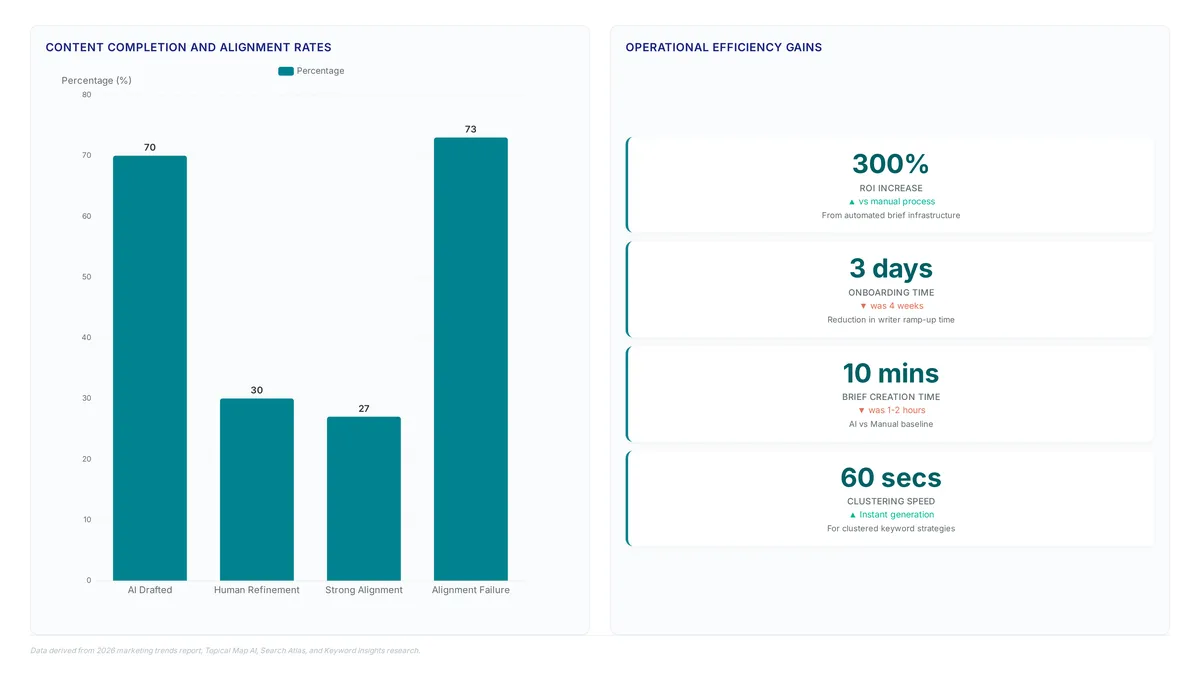
Strategic differentiation replaces data aggregation as the writer's primary function. Teams apply recovered hours to spot emerging topic opportunities generic algorithms miss. Configured workflows apply these standards automatically. Scale decouples from linear labor costs. Efficiency gains introduce dependency on initial configuration; unclear direction causes focus loss. Technology manages repetitive scaffolding of keyword research and structural requirements. Humans guide strategy and quality control. Automation delivers the strongest ROI for high-volume teams with repeatable needs, especially when logic aligns with brand voice.
Scaling Topical Authority Through SERP-Grounded Research and Indexing
Pipelines ingest real-time search data to enforce semantic clustering before drafting. Every well-briefed, topically complete article builds topical authority, influencing rankings and AI citation frequency. Platforms pairing generation with indexing integration enable quicker discovery, reducing latency between publication and indexing. Velocity without structural coherence creates noise. Rapid output conflicts with the disciplined internal linking required to signal topic depth. Isolated assets generated without mapping to existing clusters dilute relevance. This discipline prevents saturating a topic without achieving dominance. Embedding checks into brief generation allows scaling without quality loss. Structural rigor transforms raw velocity into compounding ranking power.
Validating GEO Signals, Intent Classification, and CMS Integration
Tools must classify search intent using live SERP data rather than hallucinated outputs. Effective platforms surface semantically related terms and enforce topic clusters before drafting.
| Capability | Manual Process Risk | Automated Validation |
|---|---|---|
| Intent Logic | Static keyword matching | Flexible SERP pattern analysis |
| Entity Scope | Limited to writer knowledge | Full cluster extraction |
| Output Format | Unstructured text file | Direct CMS draft |
Explicit permission layers resolve the tension between velocity and control. Analyzing thousands of search results extracts key entities a single writer might miss. The operational goal is eliminating data aggregation latency, not increasing speed. Verify your stack ingests real-time ranking factors rather than relying on static training data. Static data fails to capture shifting searcher behavior. Live ingestion ensures briefs reflect current market conditions.
About
Hannah Brooks, Marketing Operations Lead, specializes in the precise architecture of content automation pipelines. Her daily work involves auditing martech stacks to eliminate manual friction, making her uniquely qualified to analyze the inefficiencies of manual content briefs. Having evaluated countless tools against the rigorous demands of B2B production, Hannah understands that wasting three hours per brief is an operational failure, not a necessity. At Enterium, a publication dedicated to documenting how modern teams scale content with LLMs, she applies her RevOps background to dissect multi-agent systems and SERP data ingestion strategies. This article reflects her practitioner-led approach, moving beyond theoretical AI benefits to provide a reproducible framework for automated brief generation. By connecting workflow orchestration with generative engine optimization, Hannah offers a clear path for marketing leaders to transition from ad-hoc creation to a measured, data-driven content brief pipeline that integrates smoothly into existing governance models.
Conclusion
Velocity without structural coherence creates noise, not authority. Automation reduces brief creation time drastically, but static data fails to capture shifting searcher behavior. The industry moves toward semantic intelligence understanding user intent and content gaps, a shift critical for maintaining relevance in 2026. Teams must ensure systems ingest real-time ranking factors instead of depending on outdated model training. Without flexible validation, high-velocity publishing saturates topics without achieving dominance.
Mandate that your chosen stack performs live SERP pattern analysis before drafting. This requirement ensures output reflects current market conditions rather than historical averages. Reject tools relying solely on static keyword matching or unstructured text files. The goal is eliminating data aggregation latency while enforcing topic clusters automatically. If the system cannot dynamically extract entities from thousands of results, it will produce assets that are only partially complete. Prioritize platforms integrating directly with your CMS to enforce these structural checks immediately. This disciplined approach transforms raw speed into compounding ranking power.
Frequently Asked Questions
AI tools reduce brief creation from two hours to ten minutes. This efficiency allows teams to redirect saved time toward strategic oversight rather than data entry tasks.
AI can produce content that is approximately 70% complete with proper guidelines. Human editors must refine the remaining portion to ensure quality and brand alignment.
Some generators create clustered keyword strategies in as little as 60 seconds. This speed enables rapid topical mapping but requires validation to maintain semantic depth.
Automated pipelines risk data staleness during high-volatility search events where rankings shift hourly. Teams must review AI suggestions to confirm they match the desired angle.
Manual briefs often expand from one hour to three hours due to data gathering. This inefficiency prevents scaling topic coverage while preserving necessary semantic depth.
References