Dual-channel tracking fixes AI visibility gaps
Track dual-channel data to measure where AI models surface your brand and which prompts trigger those responses.
Modern content strategy fails when it ignores the mechanics of AI visibility. You cannot optimize for engines you do not monitor. Success now depends on mapping prompt mapping strategy to actual model outputs rather than guessing at query intents.
Readers will learn how dual-channel content tracking reveals the gap between published material and machine synthesis. We examine the mechanics of AI content synthesis, where tools now score raw drafts on a scale from 0 to 100 as the user types to ensure prompt alignment before publication. We analyze why leading platforms update brand sentiment monitoring and performance reports on a weekly basis, a cadence critical for maintaining relevance in fast-shifting model weights.
Finally, the discussion details how to establish a baseline for content performance tracking using verified content asset methodologies. By understanding how to track brand mentions in AI responses, organizations can move beyond vanity metrics. The goal is measurable ROI through structured content for AI that aligns with how models actually retrieve and synthesize information.
The Role of Dual-Channel Analytics in Modern Content Strategy
Defining Dual-Channel Tracking: SEO Metrics vs AI Visibility Scores
Dual-channel tracking measures content performance across traditional search indices and generative AI synthesis engines simultaneously. Traditional analytics monitor publishing cycles, Google Search Console rankings, and organic traffic volume to gauge success. These metrics assume a user actively queries and clicks a result. AI visibility operates differently; models synthesize responses from trusted sources rather than listing links. Content excluded from this synthesis remains invisible to users asking for recommendations, regardless of its SEO ranking.
Defining this gap requires prompt mapping, which identifies specific query intents that trigger brand inclusion in AI answers. Without mapping these prompts, operators cannot determine why high-ranking articles fail to appear in generated summaries. The limitation is structural: search crawlers index keywords, while AI models weight semantic authority and citation frequency.
| Metric Type | Primary Signal | User Action Required |
|---|---|---|
| Traditional SEO | Keyword Rank | Click-through |
| AI Visibility | Synthesis Inclusion | None (Passive) |
A critical tension exists because optimizing for crawler frequency does not guarantee inclusion in AI training sets or retrieval contexts. Operators relying solely on traffic data miss the signal of brand invisibility where influence happens without a click. By tracking share of voice, impression share, AI mentions, brand citations, lead progression, and multi-channel touchpoints, teams capture how visibility shapes buyer perceptions across both channels. This approach reveals impact over interaction, showing how a prospect reads an AI summary before requesting a demo.
Mapping Content Assets to Specific AI Prompts and Query Intents.
A prompt map connects specific content assets to the natural language query patterns likely to surface them in generative responses. Unlike traditional SEO, which optimizes for keyword density and backlinks, Generative Engine Optimization ensures content is structurally clear for AI extraction and synthesis. Models prioritize semantically precise data when constructing answers for users.
Operators must shift from tracking generic organic volume to isolating traffic from AI sources like ChatGPT or Perplexity. Building custom exploration reports in tools like Google Analytics allows teams to measure this emerging channel separately. Without this segmentation, a brand might appear invisible despite holding high search rankings. Research indicates 86% of AI answers include brand references when the underlying data is structured correctly, yet unoptimized content remains excluded from these summaries.
The mapping process requires identifying question-based intents rather than transactional keywords.
| Traditional SEO Focus | GEO Prompt Focus |
|---|---|
| Keyword density | Semantic clarity |
| Backlink authority | Structural extraction |
| Click-through rate | Synthesis inclusion |
However, optimizing for synthesis creates a tension: highly concise answers satisfy the AI but may reduce the incentive for a user to click through to the source site. This trade-off demands a balance between providing complete answers and retaining enough complexity to drive traffic. Brands must decide if their goal is maximum mention frequency or maximum referral depth.
Enterium recommends establishing a baseline of current AI visibility before altering content structures. Teams should audit existing assets against known query intents to identify gaps where competitors currently dominate the synthesis layer.
SEO vs AI Visibility: Why Page One Rankings Do Not Guarantee Model Mentions
High Google rankings do not force inclusion in generative engine responses. A page can rank first for a query yet remain absent when large language models synthesize answers for users. This divergence occurs because traditional SEO analytics track click-through behavior and backlink authority, whereas AI visibility depends on semantic clarity and citation frequency within model training data. Most content teams lack baselines for this second channel, creating a blind spot where brand authority erodes despite stable organic traffic.
Tracking AI visibility provides a more accurate picture of true performance in this dual environment. Relying solely on search console data ignores the AI visibility tools needed to monitor brand mentions inside generated text. The operational risk is clear: content optimized only for crawlers may never reach users who rely on direct answers. Teams must establish separate baselines for citation rates and prompt alignment to mitigate this invisibility. Without measuring both channels, a strategy protects past traffic but fails to secure future discovery.
Inside the Mechanics of AI Content Synthesis and Prompt Alignment
How Generative Engine Optimization Differs from Traditional SEO
Traditional search crawlers index keywords, but AI models respond to conversational, intent-driven prompts rather than simple keyword queries. This fundamental shift requires semantic query matching over raw keyword density to secure inclusion in generated responses. While SEO relies on backlink authority, Generative Engine Optimization (GEO) demands machine-readable structure that allows large language models to extract and synthesize facts without ambiguity.
| Feature | Traditional SEO | Generative Engine Optimization |
|---|---|---|
| Primary Input | Keyword strings | Conversational prompts |
| Ranking Signal | Backlink volume | Semantic clarity |
| Content Goal | Click-through rate | Direct citation |
| Structure | HTML hierarchy | Machine-readable logic |
Operators must map content assets directly to specific query intents to align with how engines retrieve information. Neglecting this synthesis layer risks brand invisibility, as models prioritize verifiable authority markers over persuasive marketing copy. A common failure mode occurs when teams optimize for human readability while ignoring the structural signals AI parsers require for accurate extraction. Without this data, content teams cannot distinguish between poor quality and structural invisibility.
Executing AI Visibility Gap Analysis Across Substantial Models
To capture baseline visibility, organizations should build an inventory of queries representing core buyer questions. Running these prompts across various AI platforms helps document where competitors appear while a brand remains absent.
| Model Type | Primary Citation Behavior | Detection Focus |
|---|---|---|
| Chat Assistants | Synthesized summaries | Brand mention frequency |
| Search Hybrids | Source-linked answers | URL attribution accuracy |
| Reasoning Engines | Logical deduction paths | Factual consistency |
The analysis reveals that AI visibility depends on semantic clarity rather than keyword density alone. Models prioritize structured data that directly answers intent-driven questions over broad topical coverage. A significant limitation arises when brands optimize for search rankings but fail to provide the explicit entity relationships required for model synthesis. This creates a scenario where high SEO performance correlates with zero presence in generative responses.
Mapping content assets to specific prompt intents helps close this gap. Operators must verify that product names and category definitions appear in contexts resembling natural user inquiries. Ignoring this approach risks omission from the decision-making loop of users relying on AI assistants. Without appearing in these synthesized answers, a brand effectively ceases to exist for a expanding segment of the market.
Accelerating Discovery with the IndexNow Protocol
The IndexNow protocol instantly notifies search engines of new or updated content, bypassing traditional crawl delays. This mechanism ensures content freshness reaches indexing queues immediately rather than waiting for scheduled bot visits. Operators should configure automated triggers to submit URLs the moment publication status changes to live. However, immediate submission does not guarantee immediate rendering in generative model training sets or cache updates. The limitation lies in the downstream propagation time across different retrieval systems, which varies by provider infrastructure. This verification step is critical for validating whether updated brand descriptions appear correctly in AI responses. The cost of skipping this validation is prolonged exposure to outdated brand narratives in synthesized answers.
| Step | Action | Validation Target |
|---|---|---|
| 1 | Trigger URL submission | HTTP 200 response |
| 2 | Monitor indexing window | Index presence confirmed |
| 3 | Run prompt set | Brand mention verified |
Aligning these technical checks with broader tracking workflows helps close the gap between publishing and performance visibility.
Measurable ROI from Automated Brand Sentiment and Visibility Workflows
Defining AI Sentiment as a Lagging Indicator of Content Quality
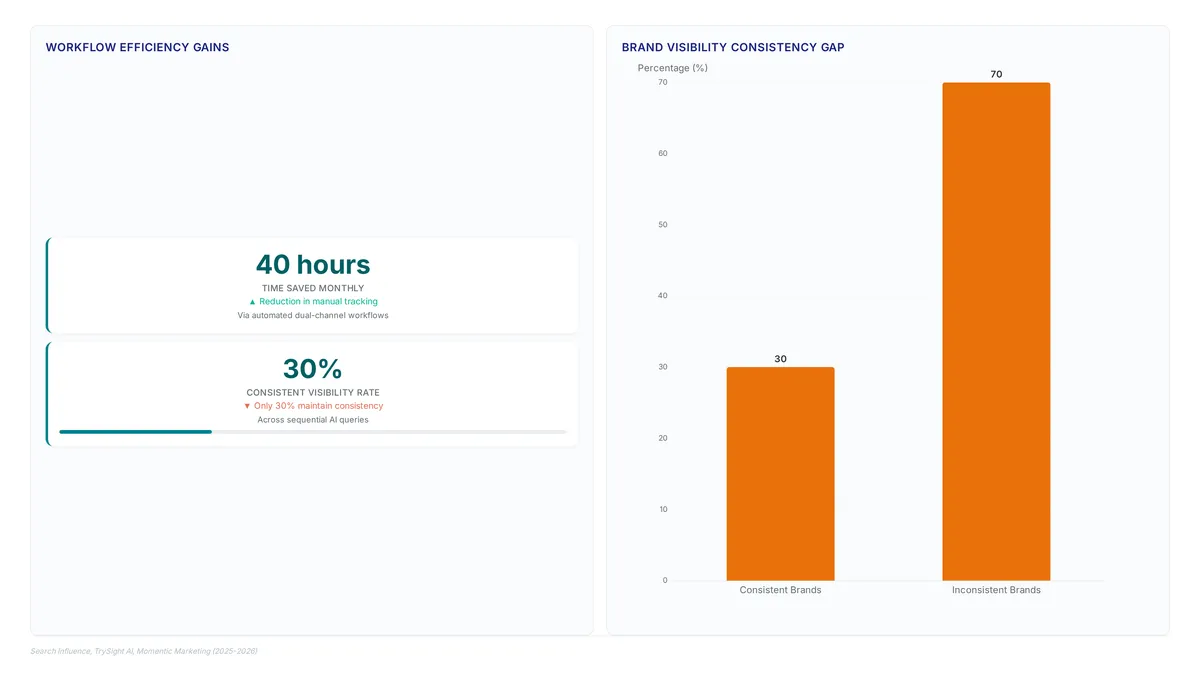
Sentiment within generative responses operates as a lagging indicator that reflects the quality of indexed content rather than real-time brand health. Operators must separate raw presence from the specific descriptive language models apply to a brand. Visibility confirms a brand appears in an answer, yet only 30% of brands maintain consistent visibility across sequential queries. This volatility means a brand might appear in one interaction but vanish or be framed differently in the next without warning. Teams establish an AI visibility baseline by mapping specific prompt intents to expected brand mentions while tracking citation frequency over time. Monitoring requires checking not for inclusion but for the tone of the synthesis. Advanced platforms provide sentiment analysis alongside visibility scores to offer a dual-channel view of performance. The temporal limitation persists because negative framing in training data remains until new, high-quality content is ingested and weighted by the model. Shifts in sentiment often signal that competitor content has influenced the retrieval layer of the model. Experts recommend automating these checks regularly since manual review cannot catch the rapid shifts inherent in generative outputs. Immediate action on negative sentiment requires publishing corrected, structured content that directly addresses the misinformation gap.
Building Unified KPI Dashboards Linking AI Visibility to Revenue Pipeline
Traffic from branded search often stems from AI-assisted exposure yet lacks reporting connections to pipeline revenue. A unified framework connects AI visibility scores and mention frequency directly to organic traffic, which feeds into lead generation and conversion metrics. This approach prevents misplaced attribution where performance media or direct visits are not recognized as downstream effects of generative engine synthesis. Teams should build automated content tracking workflows that ingest brand sentiment data alongside traditional click metrics to validate narrative control. Operators cannot distinguish between gaining raw traffic and securing actual influence in conversation-first discovery ecosystems without this linkage. Data cadence for brand performance reports in leading AI SEO tracking platforms varies, often introducing latency. Dashboards may reflect past synthesis states rather than real-time model drift, creating a blind spot during rapid news cycles. Revenue attribution models must account for this delay when correlating visibility spikes with sales pipeline movements.
Tracking AI-generated brand mentions adds value only if the workflow links those mentions to downstream conversion events rather than treating them as vanity metrics. Mapping content to specific query intents is necessary to improve visibility in engines like Perplexity and similar platforms. Ignoring this dual-channel view creates an inability to prove ROI from content that drives recognition without clicks.
Automating Closed-Loop Workflows with Automated Indexing
Automated indexing modes execute the repetitive indexing and data extraction steps required to maintain dual-channel visibility. Teams often delay content updates until traffic drops, yet waiting for traditional SEO lag indicators allows brand invisibility to persist in generative answers. A closed-loop workflow triggers immediate revision when mention frequency dips below established baselines. Operators must address the tension between update velocity and model re-indexing latency. Accelerating content changes does not guarantee immediate inclusion if the underlying semantic clarity remains misaligned with query intents. The cost of this delay is measurable because teams miss the narrow window where updated context influences synthesis before competitors displace them without automation. Sight AI's platform combines AI visibility tracking, content generation with 13+ specialized AI agents, and automated indexing. Enterprise adoption reflects this urgency as digital leaders plan to increase investment in AEO strategies during 2026 to keep pace with shifting discovery patterns. Leaders recognize that scaling these workflows requires removing human bottlenecks from the data collection phase. Experts recommend configuring thresholds that prioritize high-value query clusters over broad coverage to maximize resource efficiency. Static reporting cycles cannot support the flexible requirements of generative engine optimization.
Strategic Takeaways for Mitigating Brand Invisibility Risks
Content Decay Signals in AI Visibility vs SEO
Traffic rankings drop when traditional content decays, yet reduced mention frequency in generated responses signals AI visibility decay. Standard analytics record user clicks while generative engines synthesize answers without requiring a site visit. A page maintains stable SEO performance even as brand visibilitydrops within AI interfaces. Tracking key AI search content performance metrics shows systems prefer sources demonstrating complete topical expertise over isolated updates. Enhancing contextual relevance and authority addresses low AI brand mention frequency, though traditional tools miss this signal entirely because they measure clicks instead of synthesis inclusion. AI outputs vary over time, making tracking less precise than established SEO metrics.
Remediation paths diverge sharply, requiring separate diagnosis of these failures. High-quality online content and third-party validation drive SEO recovery, whereas improving AI visibility places greater emphasis on contextual relevance and consistency across sources. Traffic data alone creates a blind spot where brands appear healthy in dashboards while disappearing from conversational interfaces. Dual-channel diagnostics prevent this invisibility by treating citation rates as distinct from click-through rates. Ignoring this split risks erasure from the very interfaces users increasingly trust for information retrieval.
Executing Dual-Lens Diagnostics for Refresh Prescriptions
Parallel diagnostics on SEO decay signals and AI visibility metrics isolate the root cause of performance drops. Traditional analytics track declining traffic, yet generative engines synthesize answers without requiring a site visit, meaning a page maintains stable search rankings while suffering drops in brand visibility within AI interfaces. This divergence requires distinct refresh prescriptions: structural SEO updates ensure a structurally sound website, while focused optimization addresses contextual relevance and brand authority.
Identifying gaps in topical expertise or authority determines when to update content for AI visibility rather than simple ranking demotion. Strengthening interconnected content clusters fixes low AI brand mention frequency, yet traditional tools miss this signal entirely. Thorough guides and detailed how-to content tend to perform best, as AI systems prioritize sources that demonstrate complete topical expertise.
Conflating these workflows leads to ineffective fixes, making separation necessary. Most dashboards aggregate these signals, hiding the specific decay mode. Operators must distinguish between gaining traffic and gaining narrative control to prescribe the correct intervention.
| Decay Signal | Primary Cause | Refresh Prescription |
|---|---|---|
| Traffic/Rank Drop | Crawl errors, backlink loss | Structural SEO audit |
| Mention Frequency Drop | Lack of topical expertise, inconsistent authority | Contextual optimization |
Fixing the wrong channel leaves the brand absent from generative responses despite high search rankings, resulting in compounding invisibility. Dual-channel tracking prevents this by aligning the repair mechanism with the specific failure mode.
Building a Decay-Driven Refresh Calendar
This approach flags assets showing consistent volatility or decline, ensuring updates address actual decay signals. Content performance tracking in 2026 requires this dual-lens approach to remain effective.
| Metric | Decay Signal | Refresh Trigger |
|---|---|---|
| Organic Traffic | Month-over-month drop | Two consecutive periods |
| AI Visibility Score | Mention frequency drop | Two consecutive periods |
| Rankings | Position slip | Combined with traffic loss |
Outdated brand descriptions create a specific problem where AI engines may exclude content from synthesis contexts entirely. Traditional search might demote a page, but generative models simply ignore stale data, leading to brand invisibility. Enterprises must distinguish between structural SEO issues requiring technical fixes and optimization needs demanding factual updates and enhanced authority.
A dual-lens diagnostic prevents misallocated engineering hours on content that simply lacks semantic freshness. Operators should deploy dashboards that separate these signals to prescribe the correct intervention type. Prioritizing assets where both channels show simultaneous degradation indicates fundamental relevance loss. Brands become invisible to query engines before traffic numbers reflect the issue if AI visibility metrics are ignored. Waiting for SEO metrics to crash often means the brand has already lost the semantic battle in model weights. Proactive monitoring captures the inflection point where content optimization for AI becomes necessary.
About
Sofia Marchetti is a B2B Content Strategist specializing in how automated content systems drive pipeline through topical authority and durable distribution. Her decade of experience in B2B SaaS demand generation uniquely positions her to analyze dual-channel content tracking, where traditional SEO metrics must now coexist with AI visibility scores. In her daily work connecting content operations to revenue outcomes, Sofia observes how prompt mapping strategies and structured content directly influence whether brands surface in generative engine responses. This article reflects her practical approach to measuring content performance across both search engines and LLM platforms like Perplexity and ChatGPT. As a key voice for Enterium, a publication dedicated to vendor-neutral content automation methodologies, Sofia translates complex generative engine optimization concepts into actionable frameworks for technical marketers. Her analysis avoids hype, focusing instead on reproducible steps to establish baselines for brand sentiment monitoring and optimize content pipelines for the realities of AI-driven discovery.
Conclusion
Scaling content operations reveals that high search rankings no longer buffer against semantic obsolescence. When content asset libraries grow without dual-channel monitoring, organizations incur the hidden cost of engineering hours spent fixing structural errors on pages that generative models have already ignored due to stale facts. This misalignment creates a scenario where traffic remains stable while brand influence evaporates within AI synthesis. You must shift from reactive patching to a proactive refresh calendar triggered specifically by mention frequency drops rather than waiting for organic traffic to decline.
Implement a policy requiring immediate factual audits for any asset showing two consecutive periods of reduced AI visibility, regardless of its current search position. This approach isolates relevance loss from technical debt, ensuring teams update information rather than rebuilding healthy infrastructure. Start by auditing your top twenty performing pages this week to check if their brand descriptions match current market positioning, as outdated narratives directly cause the exclusion of your content assets from high-value AI responses. Prioritizing semantic freshness over raw volume ensures your brand maintains authority as the industry moves toward quality-of-interaction metrics.
Frequently Asked Questions
High rankings do not ensure synthesis inclusion because models prioritize semantic authority over crawler frequency. Research indicates 86% of AI answers include brand references only when data is structured correctly for extraction.
Traditional SEO tracks clicks while AI visibility measures passive synthesis inclusion without user action. This distinction matters because models prioritize semantically precise data, meaning 86% of answers reference brands with proper structure.
Prompt mapping connects assets to natural language queries that trigger brand inclusion in summaries.
Operators must build custom exploration reports to isolate AI traffic from standard web referrals.
Dual-channel tracking monitors both search indices and synthesis engines to spot invisible brand gaps.
References