AI content distribution: Fix invisible assets now
Content production hit a breaking point in 2026. With countless pieces published daily, the "publish and pray" model guarantees digital oblivion. Saturation killed passive discovery. Today, AI content distribution drives modern search visibility, not human-centric SEO alone. Your content's fate depends on technical readiness for automated consumption.
This guide details the mechanics of fast indexing and why structured data acts as the bridge for AI comprehension. We explore why Generative Engine Optimization demands rigorous auditing workflows to expose assets hidden from current search architectures. You will see exactly where content indexing gaps bury high-quality material.
The solution requires implementing IndexNow protocol standards and running regular AI visibility audits. Without these safeguards, your data stays trapped in silos or ignored by crawlers. Strategic application transforms static assets into flexible inputs for AI search optimization. Treat every publication as a data point requiring explicit permission to be read and cited by intelligent systems.
The Role of AI Content Distribution in Modern Search Visibility
Defining AI Content Distribution Beyond Traditional Search Indexing
Stop waiting for crawlers. AI content distribution actively pushes structured updates to indexing engines. Legacy SEO chases link graphs to surface URLs, but this workflow ensures models like ChatGPT and Claude parse structured data directly. Writing expert articles is half the battle; if they do not surface in AI models like ChatGPT, Claude, and Perplexity, they deliver zero value. The mechanism shifts from ranking pages to validating discrete facts for synthesized responses.
Traditional indexing crawls links at irregular intervals, often leaving fresh assets invisible for days. AI-driven distribution uses protocols like IndexNow to signal changes instantly, slashing the latency between publication and model ingestion. Ambiguous headers or missing schema markup hinder ingestion by synthesis engines. Operators must prioritize contextual completeness over keyword density.
Visibility now depends on machine readability, not human navigation. Technical solutions enforce structural standards to help assets pass the initial ingestion gates of modern search platforms.
Applying Generative Engine Optimization for ChatGPT and Gemini Visibility
Generative Engine Optimization structures content with specific formats and keywords so AI models parse, cite, and increase material effectively. Optimization now includes AI visibility, requiring rigorous formatting to perform well on platforms like ChatGPT and Gemini. Traditional SEO targets link graphs for human click-through; this approach prioritizes machine readability for synthesized responses. A significant majority of digital leaders plan to increase investment in AI optimization as discovery shifts from rankings to AI-generated answers.
Shift focus from keyword density to semantic clarity. Content must answer specific queries with precise, self-contained factual statements rather than narrative fluff.
| Feature | Traditional SEO | Generative Engine Optimization |
|---|---|---|
| Target | Human readers | AI parsers and synthesizers |
| Format | Long-form articles | Structured Q&A and lists |
| Success | Clicks and session time | Citations and direct answers |
Broad topics without granular data points limit citation potential. Exclusion from the synthesized text block users see first becomes the direct consequence. Deploy specialized solutions to restructure existing assets into machine-parsable formats. This ensures high-fidelity extraction rather than probabilistic guessing by the model. Audit current content for semantic density and restructure headers to match natural language queries.
Traditional Search Queries Versus Direct AI Assistant Questions
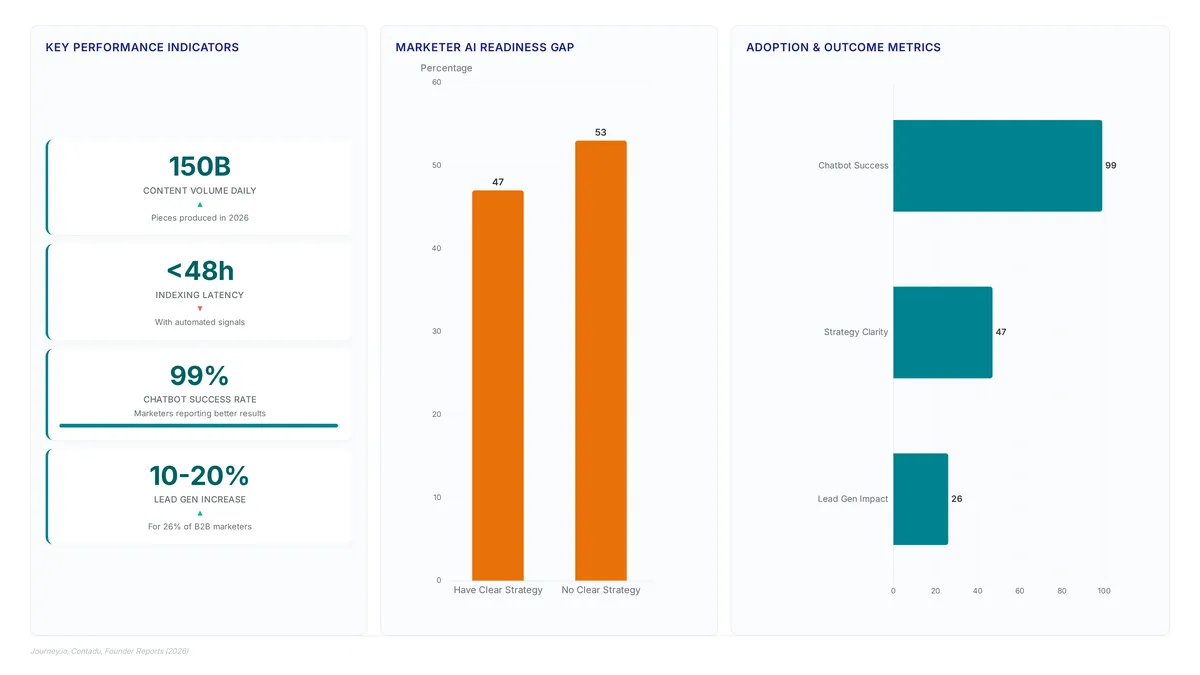
Traditional search returns ranked links while AI assistants synthesize direct answers from parsed text. This shift demands Generative Engine Optimization rather than simple keyword matching. Users typing queries into search bars expect a list of blue links to explore. Users asking direct questions to AI assistants expect a definitive, sourced conclusion. Only approximately 40% to 47% of marketers possess a clear, practical plan for how their teams use AI to research, create, improve, distribute, and measure content effectively.
The operational difference lies in the content indexing mechanism. Traditional engines crawl and rank based on authority signals; AI models ingest structure to validate facts for response generation. High-value assets remain invisible to synthesis engines regardless of their SEO performance without explicit structural formatting.
| Feature | Traditional Search Queries | Direct AI Assistant Questions |
|---|---|---|
| Output Format | Ranked list of URLs | Synthesized natural language answer |
| User Goal | Exploration and comparison | Immediate factual resolution |
| Optimization Target | Click-through rate and backlinks | Citation frequency and factual clarity |
| Visibility Driver | Domain authority and page speed | Structured data and topical completeness |
Writing for human scan-reading conflicts with writing for machine extraction. Over-optimizing for narrative flow obscures the discrete data points AI models require for accurate citation. Excessive structuring may degrade the human reading experience if not balanced carefully. For 26% of US B2B marketers, the implementation of chatbots has increased lead generation by 10-20%, indicating that direct engagement channels reward this structural clarity. 99% of marketers report improved results when using chatbots as part of their distribution and engagement strategy. Adopt solutions to audit content structures, ensuring assets are formatted for both human consumption and machine synthesis without compromising either.
Mechanics of Fast Indexing and Structured Data for AI Models
IndexNow Protocol Mechanics for Instant Crawler Notification
Push URL updates directly to search engines. This eliminates the latency inherent in passive crawling schedules. The IndexNow protocol forces immediate re-crawling upon publication, closing the window where new assets sit invisible while competitors capture early engagement. Traditional methods depend on engine-side scheduling, leaving content discovery to chance.
- Send a signal to the search engine.
- Receive acknowledgment that the crawler notification has entered the processing queue.
Rapid indexing serves the strategic need for synthesis readiness. AI engines evaluate discrete facts for inclusion in generated answers rather than simply ranking isolated URLs. Visibility hinges on this immediate availability.
| Feature | Passive Crawling | IndexNow Push |
|---|---|---|
| Trigger | Engine Schedule | Content Update |
| Latency | Days | Minutes |
| Reliability | Variable | High |
Embed key storage into deployment pipelines to avoid service interruptions. This workflow prioritizes semantic clarity and structural completeness over traditional SEO metrics like backlink counts. Automating this handshake prevents high-value assets from remaining stranded outside the synthesis layer.
Implementing Header Hierarchies and Schema Markup for AI Extraction
Place target keywords within H2 headings to establish clear semantic boundaries for model extraction. Generative Engine Optimization demands factually dense language to improve citation accuracy, rejecting vague hedging. Sites using structured data markup achieve higher visibility in AI responses than unmarked content. Explicit tags define entities, allowing parsers to skip noisy prose.
- Define article metadata using JSON-LD blocks within the HTML head.
- Align header hierarchies with the logical flow of key information.
- Lead sections with direct answers to enable immediate snippet extraction.
Lead with direct answers in one or two crisp sentences. This constitutes a core GEO practice. Factually dense, authoritative language enables Large Language Models to trust and cite without extensive inference. Balance semantic richness against performance constraints.
| Feature | Unstructured Text | Structured Markup |
|---|---|---|
| Extraction Rate | Low | High |
| Context Retention | Variable | Explicit |
| Citation Probability | Minimal | Significant |
Deploying this schema strategy guarantees machines interpret technical claims correctly. Sole reliance on natural language processing often causes misattribution or ignored data points when context lacks clarity. The constraint involves upfront engineering effort versus long-term discoverability in automated agents. Treat markup as a core delivery format instead of an optional add-on. Unstructured data leaves visibility to chance in generative interfaces.
Critical Configuration Failures Blocking AI Crawler Access
Restrictive robots.txt directives and authentication walls immediately block AI crawlers, causing total content invisibility. Search engines cannot parse pages when user-agent rules deny access to bot clusters, rendering Generative Engine Optimization efforts futile. Public assets require accessibility without login requirements or paywalls because AI crawlers cannot index restricted content. Material behind login screens remains undetectable to public indexing systems, offering no solution for teams asking how to fix content not indexed by Google.
Audit access logs to identify accidental blocks on critical paths. Legacy security configurations often inadvertently reject legitimate crawler IP ranges.
- Review robots.txt files for overly broad
Disallowstatements affecting news or blog directories. - Verify that no HTTP 401 or 403 status codes serve public-facing articles.
- Test URL accessibility using standard fetch tools to confirm crawler simulation success.
Some organizations restrict data to protect intellectual property, yet this strategy guarantees exclusion from AI-generated answers. Prioritize open access for public assets when troubleshooting poor AI visibility.
Insert automated access validation gates within the deployment pipeline. This prevents restricted content from reaching production. Only intended private assets remain hidden while public content achieves immediate discoverability. Perfectly structured data remains invisible to the wider system without this check.
Strategic Application of Auditing and Amplification Workflows
Auditing Content Distribution Gaps and AI Visibility
Start by assessing whether key assets are being crawled and indexed. Meaningful portions of content may remain invisible without active sitemap maintenance or submission protocols. Create a full inventory mapping distribution channels to identify where assets remain siloed. Companies implementing AI-driven distribution strategies see significant increases in content engagement compared to manual methods, yet this gain is impossible if the underlying assets are invisible to crawlers.
Test for AI visibility gaps by prompting models with queries related to the brand or category. If the system fails to retrieve or summarize the organization's published data, a distribution gap exists regardless of content quality. This disconnect often stems from a failure to align technical indexing protocols with generative engine requirements.
Passive crawling leaves significant portions of the content library unindexed. Many AI models prioritize recently updated or explicitly submitted URLs, meaning static archives frequently disappear from retrieval contexts. A one-time audit is insufficient. Continuous monitoring of content visibility across both traditional search indexes and generative answer engines is necessary. Integrate these visibility checks into regular deployment cycles to ensure new assets are immediately scannable. Without this rigorous validation, even high-value content remains an invisible asset, unable to drive engagement or inform model responses.
Amplifying Content Across Owned Channels Within 24 Hours
Publish content to the primary domain and trigger immediate indexing before executing cross-channel amplification. Timing is critical: publish on the site first, trigger indexing immediately, and execute amplification across channels within the same 24 hours. Repurpose long-form assets into formats suitable for specific channels, such as summaries or threads, rather than posting raw links alone. AI systems can identify opportunities to repurpose existing content for different channels, formats, or audience segments effectively. If the source URL lacks crawl status, downstream social posts may fail to drive meaningful traffic or attribution for generative engines.
| Workflow Stage | Action | Technical Requirement |
|---|---|---|
| Publication | Host canonical article | Server responds 200 OK |
| Indexing | Submit via protocol | Sitemap or API push |
| Amplification | Post derivatives | Link to canonical URL |
Posting social teasers before the canonical URL returns a successful crawl status severs the attribution chain. Speed is necessary, but premature amplification of unindexed content wastes the engagement potential of owned channels. Operational rigor matters; teams often sacrifice the verification step to meet arbitrary time targets, resulting in invisible assets.
Couple indexing verification with automated distribution triggers. This prevents the dilution of authority across unindexed fragments.
Tracking AI Brand Mentions and Competitive Positioning
Validate brand presence by querying AI models for category-level, problem-focused, and comparison questions. Tracking categories include category-level questions, problem-focused questions, and comparison questions. Document which entities appear in responses to identify competitive gaps where rivals dominate but the brand remains absent. This audit reveals specific content opportunities rather than relying on anecdotal visibility.
| Query Type | Focus Area | Operational Action |
|---|---|---|
| Category-level | General market definitions | Verify brand inclusion in top-tier lists |
| Problem-focused | Specific user pain points | Map solutions to known failure modes |
| Comparison | Direct competitor sizing | Correct sentiment or feature omissions |
Test these vectors regularly to catch drift before it solidifies into model training data. The AI visibility audit methodology provides a structured framework for this assessment across different generative engines. Correcting a missing mention often requires re-indexing the source page before the AI model updates its knowledge base.
This approach ensures that Generative Engine Optimization efforts yield measurable improvements in share of voice. Failure to monitor these signals allows competitors to define the category narrative unchallenged. Integrate these findings into the broader content distribution workflow.
Implementation Checklist for Scaling AI-Ready Distribution
Defining the Automated Distribution Workflow Architecture
Deterministic pipelines where CMS publication instantly triggers indexing protocols form the backbone of an effective AI content distribution strategy. Manual workflows stumble because they rely on operator availability, while automated systems execute distribution minutes after publishing. Three layers comprise this architecture: the content repository, the signaling mechanism, and the internal linking graph.
- Configure the CMS to emit a IndexNow signal immediately upon status change to published.
- Establish internal linking rules that update adjacent content nodes to surface new assets to crawlers.
- Validate that structured data payloads remain intact during the transmission phase.
Latency destroys Generative Engine Optimization efforts if automation is absent. Reliable systems replace manual processes prone to human error with consistent execution logic. Content gets indexed, internally linked, and distributed within hours of publishing when the workflow functions correctly. Encoding a broken process into logic only accelerates failure. Validate mechanical steps by hand before automating them. AI citation tracking remains the missing layer in most distribution strategies. Skipping manual validation risks scaling invisibility instead of reach. Systematic propagation of indexing errors across the entire content estate becomes the penalty for skipping this phase.
Executing the Seven-Point Implementation Checklist
Activate IndexNow signals to compress indexing latency from days to under 48 hours. Manual submission creates bottlenecks that delay visibility across search and AI ingestion layers. The workflow begins when the content repository triggers an immediate protocol ping upon publication. This mechanical step removes human latency from the critical path of discovery. Configure your publishing stack to emit these signals automatically without manual intervention. Enterium deployment patterns show that connecting CMS hooks to indexing APIs prevents asset invisibility. Strict schema adherence is the constraint; malformed payloads get rejected silently by crawlers. Content lacking valid structured data fails to populate knowledge graphs regardless of signal speed.
Apply Generative Engine Optimization principles to structure content for machine consumption patterns. AI models prioritize clear entity relationships over keyword density when synthesizing responses. Format headers hierarchically and define explicit entity attributes in markup. This approach ensures that Large Language Models can accurately attribute facts to your source. A common failure mode involves optimizing for human readers while neglecting machine parseability. High-quality prose remains invisible to automated summarization engines when structural data is missing. Enterium solutions enforce these structural constraints at the template level to guarantee compliance.
Distribute every asset across three or more channels within the initial 48-hour window. Multi-channel presence increases the probability of crawler discovery through diverse entry points. Automation tools should handle the replication of content summaries to social and feed endpoints. Relying on a single channel exposes the distribution pipeline to single-point failures. Minimal cost accompanies this redundancy compared to the risk of total obscurity. Teams often skip this step due to the perceived effort of manual cross-posting. Enterium workflows execute this expansion automatically, ensuring no published piece sits isolated.
Consistency of execution across assets matters more than bandwidth. Teams revert to ad-hoc processes that degrade over time without rigid automation. Enterium architectures maintain this discipline by hard-coding these requirements into the pipeline.
Measuring AI Visibility Scores and Iteration Cycles
Establish a monthly review cadence to connect performance data directly to the next content planning cycle. This rhythm forces iteration based on actual model behavior rather than static keyword rankings. Track AI visibility trends over weeks to detect if the brand appears in more responses. Research from AirOps highlights this volatility, noting that only 30% of brands stay visible from one answer to the next in AI search results (source). A single snapshot provides false confidence regarding distribution success. Evaluate four distinct signals to determine if content truly performs for AI models.
| Metric Category | Measurement Focus | Operational Action |
|---|---|---|
| Citation Frequency | How often sources quote your text | Expand context around cited claims |
| Share of Voice | Presence in LLM outputs for target queries | Refine topic clustering |
| Lead Quality | Intent signals from AI-referred traffic | Adjust tone for decision-makers |
| Branded Search | Growth in queries post-AI recommendation | Increase brand entity density |
Traditional SEO dashboards no longer tell the whole story when optimizing for AI models. Content may be perfect yet never retrieved if this shift is ignored. Automate these checks to flag drops in citation frequency immediately. Competitors displace assets in model weightings silently when iteration does not occur monthly.
About
Daniel Reyes, Head of Content Engineering at Enterium, architects production-grade AI content pipelines where visibility equals existence. With over a decade in data and ML platform engineering, Reyes specializes in the precise mechanics of RAG systems, vector retrieval, and orchestration layers that determine whether content reaches AI models or remains invisible. His daily work involves debugging indexing failures and optimizing ingestion paths, directly informing this analysis of Generative Engine Optimization (GEO) and distribution gaps. At Enterium, a B2B publication dedicated to documenting how teams scale content with LLMs, Reyes applies rigorous engineering standards to content automation. He moves beyond theoretical SEO to address the hard constraints of AI search optimization and structured data requirements. This article translates his hands-on experience building evaluation harnesses and quality gates into actionable strategies for ensuring content is indexed quickly and accurately by generative engines. By focusing on the underlying pipeline architecture rather than surface-level tactics, Reyes provides the technical clarity needed to solve content distribution challenges in an AI-first environment.
Conclusion
Manual distribution creates a fragile supply chain where assets rot before reaching critical mass. The operational cost of ad-hoc posting time, but the total loss of compounding visibility occurs when pieces fail to hit three or more channels within the initial 48-hour window. Stop treating publication as an event. Manage finished assets as reusable inventory for maximum efficiency. This shift demands a rigid timeline where every new piece undergoes automated expansion immediately upon approval. Without this structural discipline, teams will continue to see their lead generation potential capped despite high-quality writing.
Mandate that all future content workflows include automated cross-channel deployment before human review cycles begin. This ensures that indexing latency remains under 48 hours and prevents the bottlenecks inherent in manual submission. Map your current content pipeline this week to identify exactly where assets sit idle after final approval. Implement a rule that no piece moves to "published" status without a verified plan for multi-channel repetition. Anchoring your strategy to these specific timing constraints secures the content pieces necessary to dominate AI search results.
Frequently Asked Questions
Ambiguous headers prevent AI parsers from reading your data correctly.
Manual submission creates bottlenecks that delay visibility for your latest publications. Using instant update protocols reduces indexing latency from days to under 48 hours, ensuring your data reaches models before competitors dominate the conversation.
Your assets will likely suffer digital oblivion in this saturated market environment.
AI models prioritize structured facts over narrative fluff for synthesized answers.
Legacy link graphs fail because AI models parse structured data directly instead.
References